Tree tattoos work best when the species, condition, and placement are chosen before the decorative extras. A broad oak, narrow pine, hanging willow, exposed root system, and leafless tree all create different silhouettes before symbolism enters the conversation.
Fashionuer already uses nature scenes, mysterious forests, bare trees, and oak imagery inside broader men’s tattoo articles, but current indexed results did not surface a dedicated tree-tattoo guide for guys. This page therefore focuses on the tree itself rather than turning every design into another generic nature sleeve.
Current 2026 tattoo coverage also supports more than one visual language. Bold blackwork and realism remain useful for large nature pieces, while fine-line and geometric work can suit simpler trees when the artist preserves enough negative space.
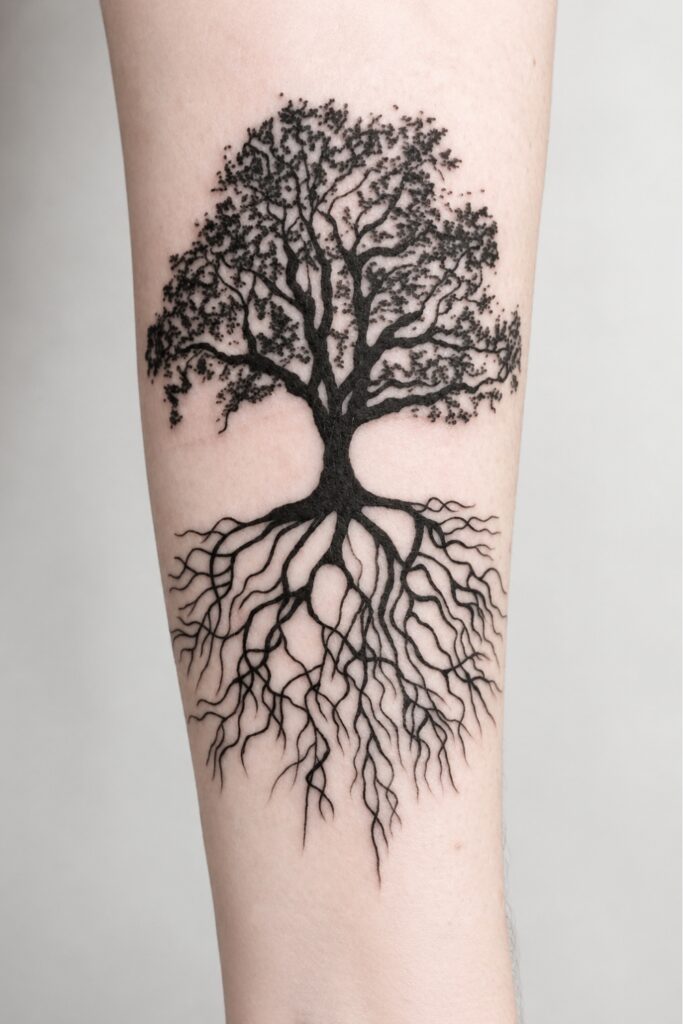
1. Rooted Oak Tree
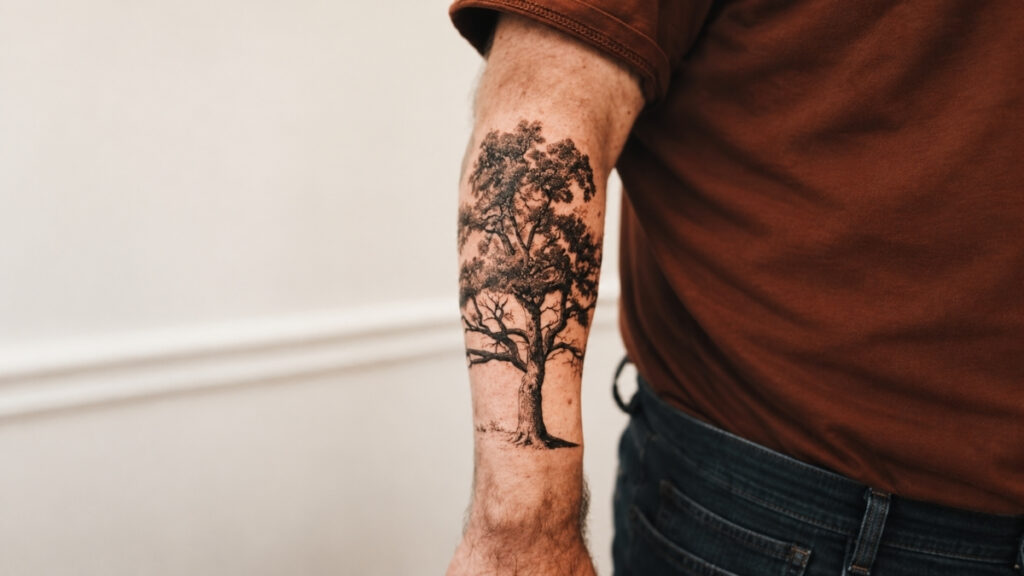
Use a mature oak with thick trunk, broad canopy, and exposed roots. Keep root lines substantial enough to remain separate.
Oak is commonly associated with strength, endurance, stability, and time.
Best for: forearm, upper arm, chest; bold black-and-gray.
 Save
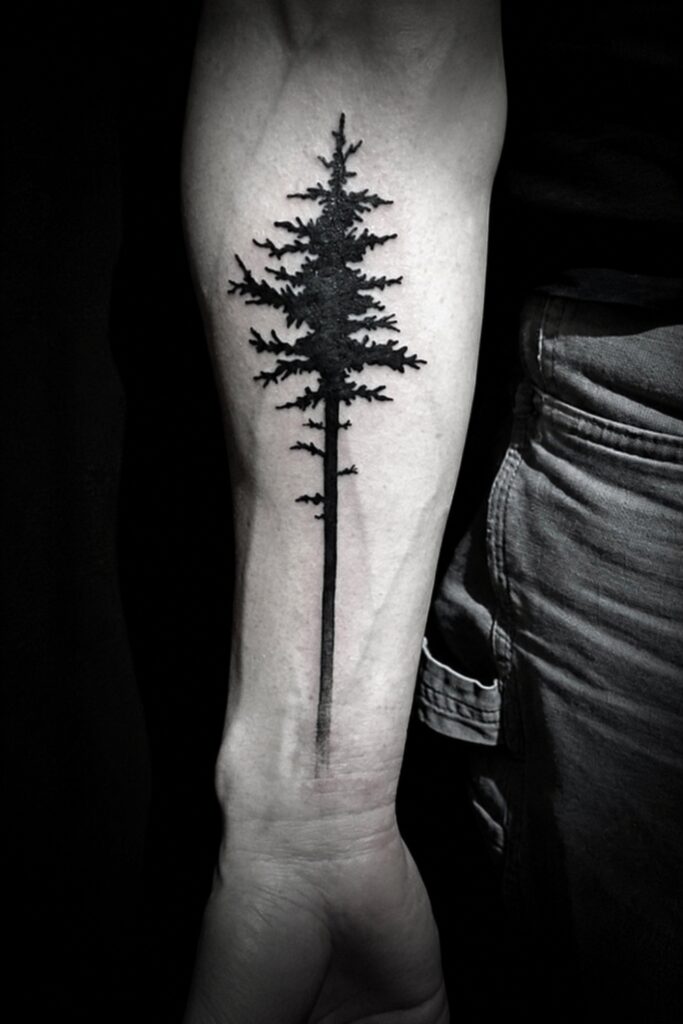
2. Lone Pine Tree
Run one evergreen vertically down the forearm, calf, or back of arm. Suggest needles selectively instead of drawing every branch equally.
Pines are commonly linked with endurance and longevity.
Best for: forearm, calf, back of arm; fine line or blackwork.
 Save
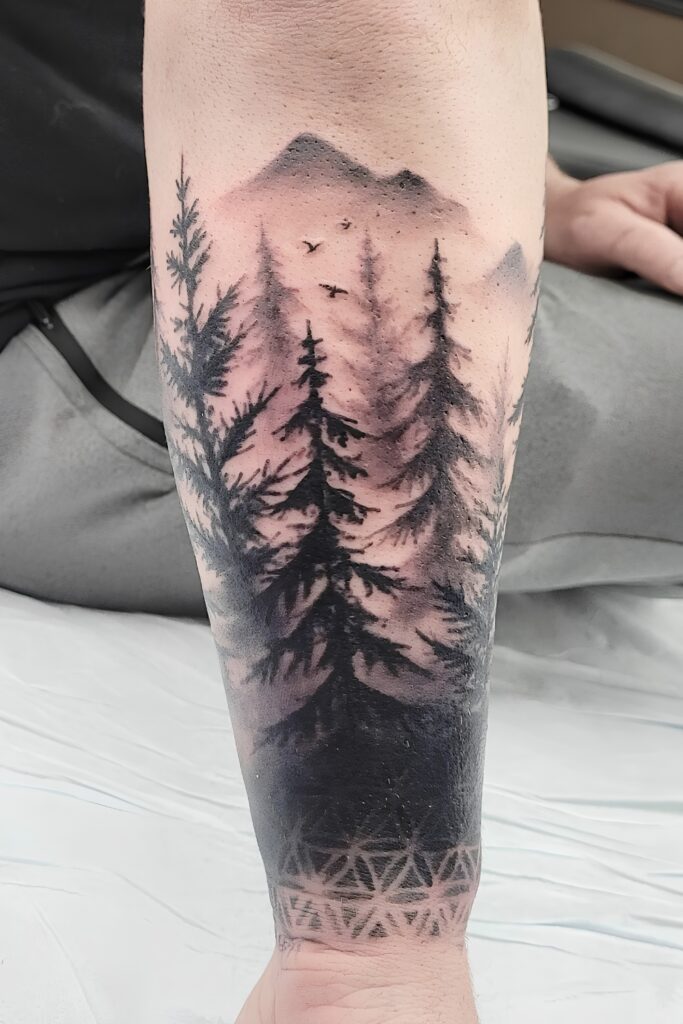
3. Pine Forest + Mountain Ridge
Layer darker foreground pines against lighter trees and a simple mountain ridge. Leave open sky between canopy and peaks.
Nature-tattoo guidance emphasizes negative space because crowded forest trunks can lose clarity.
Best for: half sleeve, calf, outer forearm.
 Save
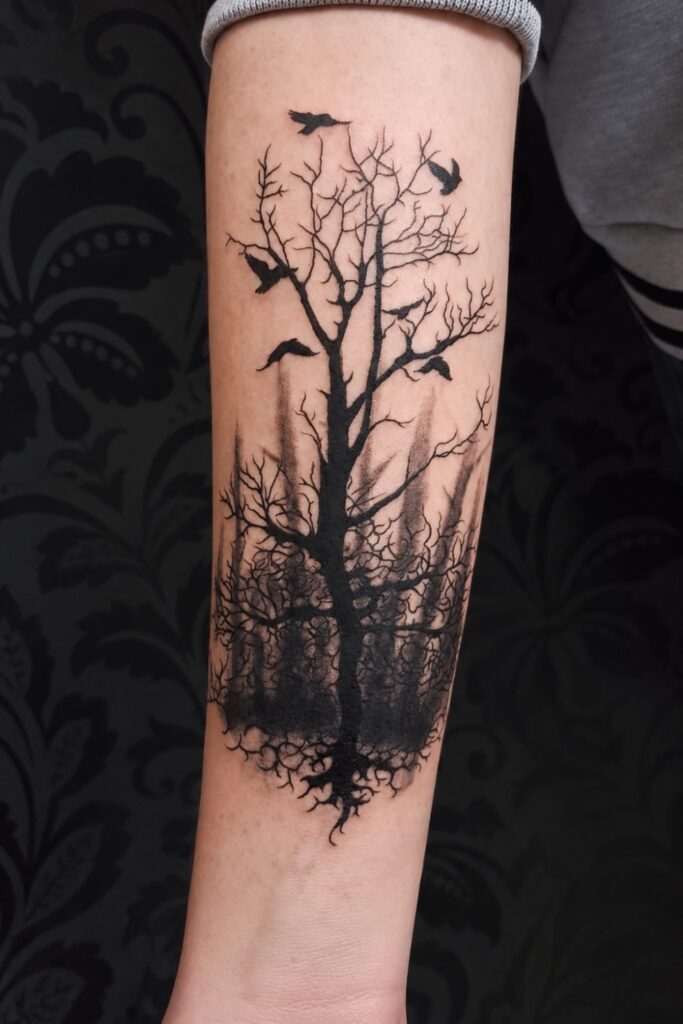
4. Bare Tree + Birds
Use a leafless tree with irregular branching and a small flock moving away from one side. Keep birds sparse.
Bare trees can suggest loss, transition, endurance, or the end of a chapter, depending on the wearer.
Best for: chest, shoulder, upper arm.
 Save
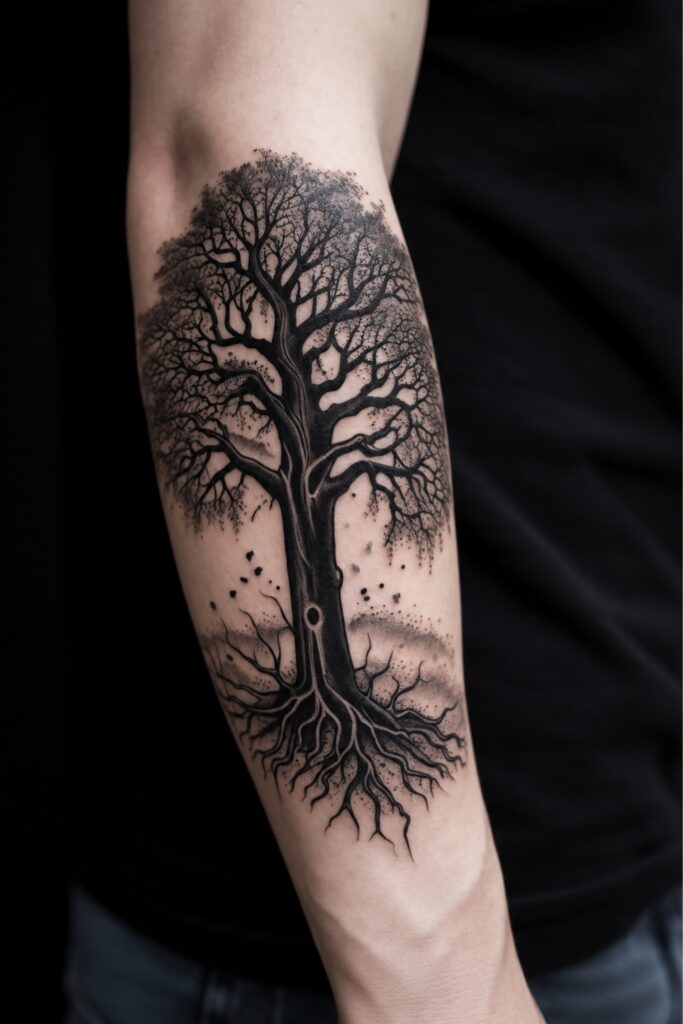
5. Tree of Life
Use a circular composition where roots and branches echo one another around an open center. Simplify knotwork at smaller sizes.
Tree-of-Life imagery is commonly associated with connection, growth, balance, and continuity across several traditions.
Best for: upper arm, chest, back.
 Save
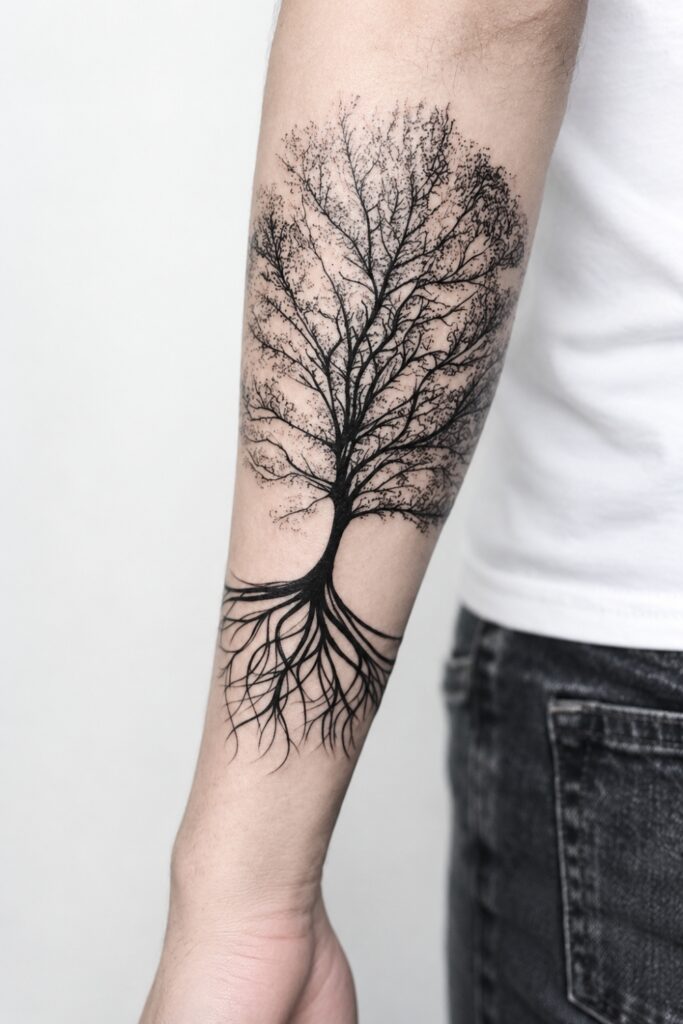
6. Exposed Roots Forearm Tree
Start the trunk around mid-forearm and let prominent roots spread toward the wrist. Keep the canopy quieter.
Roots commonly suggest grounding, ancestry, family, place, or unseen support.
Best for: outer forearm, calf.
 Save
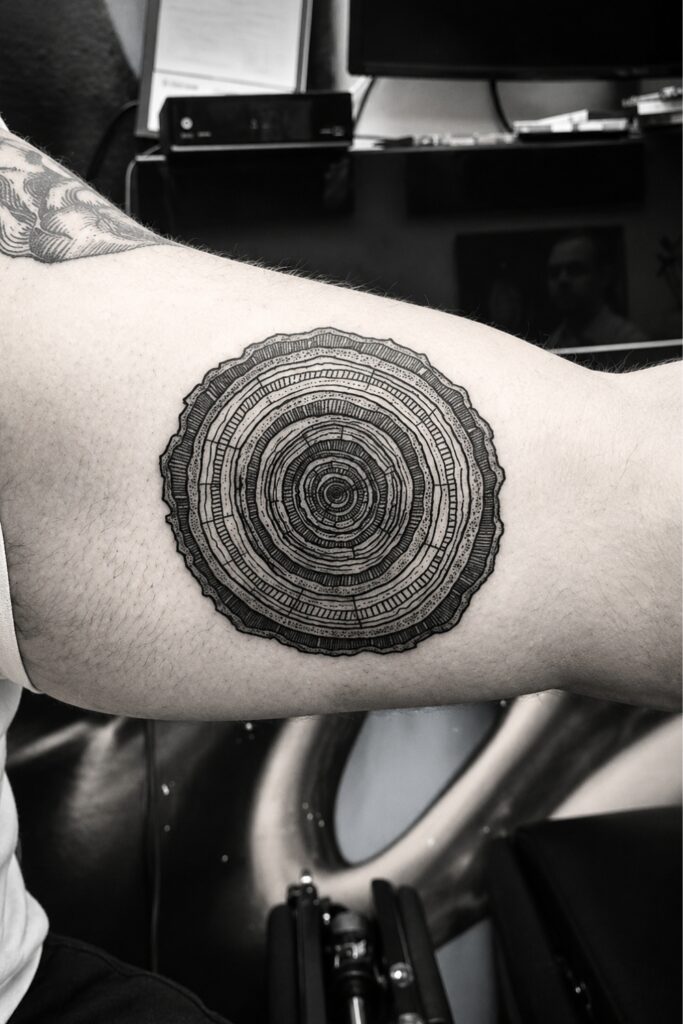
7. Tree Ring Cross-Section
Tattoo a trunk cross-section with concentric growth rings, natural cracks, and selective shading. A meaningful ring can be subtly emphasized.
This is a cleaner option for men who like tree symbolism but not literal landscapes.
Best for: inner forearm, upper arm, calf.
 Save
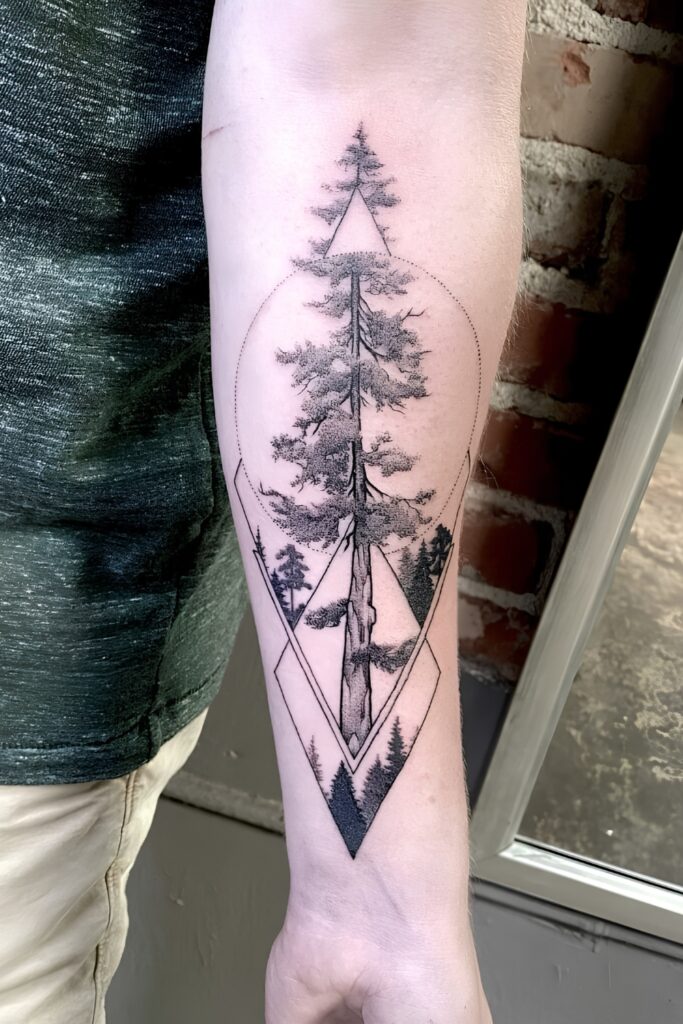
8. Geometric Tree
Combine an organic tree with a circle, triangle, or measured line system. Let a few branches break the frame.
Fine-line geometry requires an artist with strong healed linework because long straight lines reveal inconsistencies.
Best for: forearm, upper arm, calf.
 Save
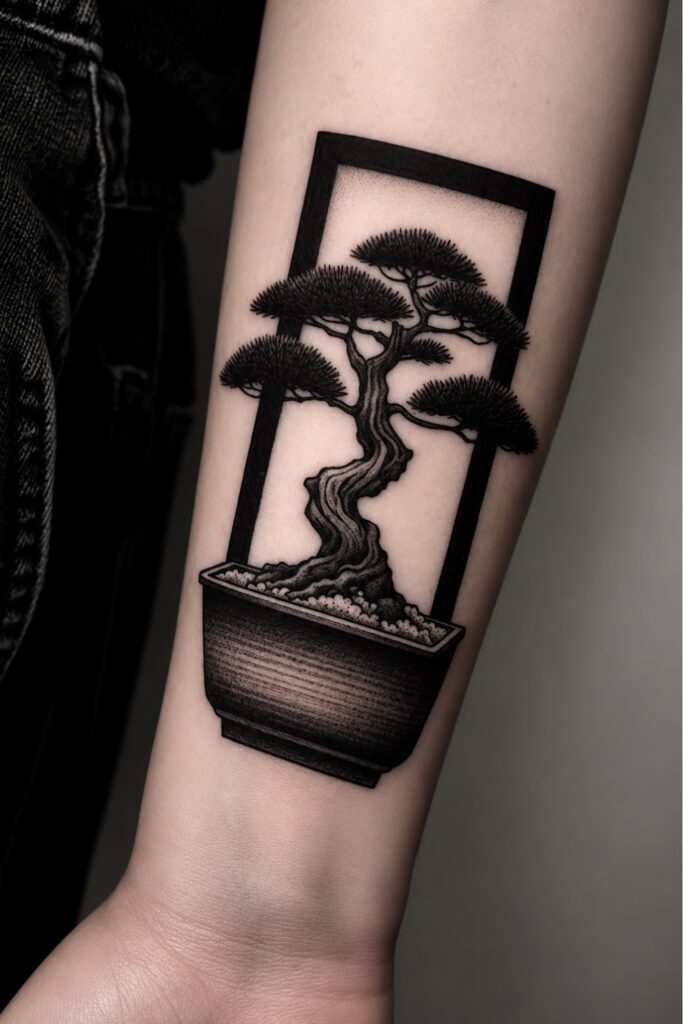
9. Bonsai Tree
Choose a windswept bonsai with a curved trunk and controlled foliage masses. Keep the pot or ground line simple.
Bonsai imagery is often connected with harmony, patience, cultivation, and balance.
Best for: forearm, calf, thigh.
 Save
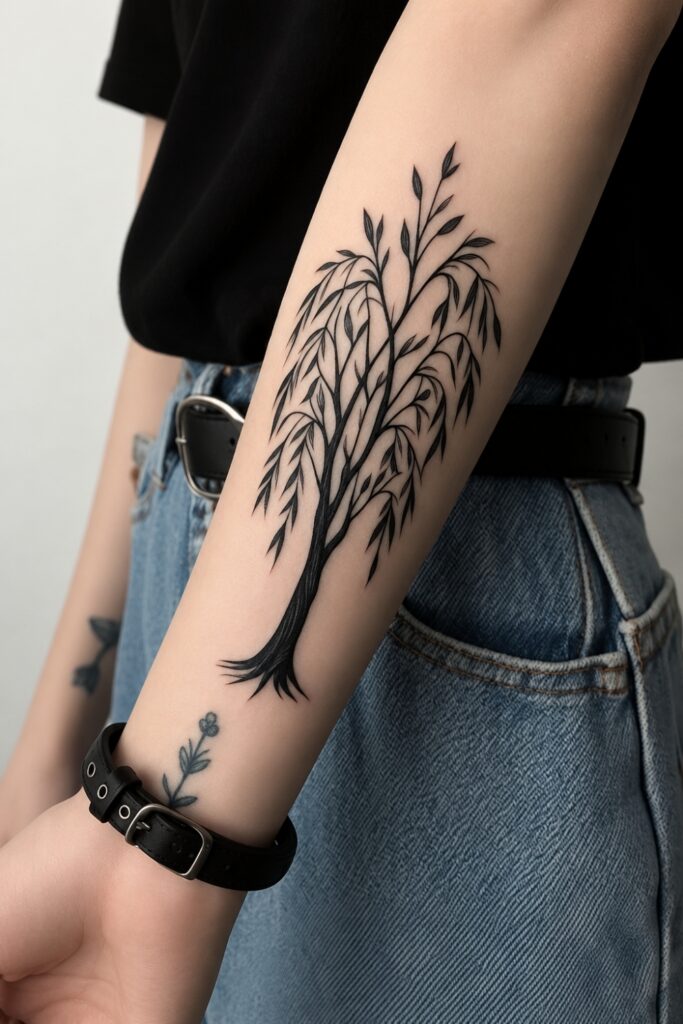
10. Willow Tree
Use a wide canopy with hanging branches and enough negative space to keep them soft rather than muddy.
Willows are often interpreted through adaptability, healing, emotional depth, or connection to place.
Best for: shoulder blade, chest, thigh.
 Save
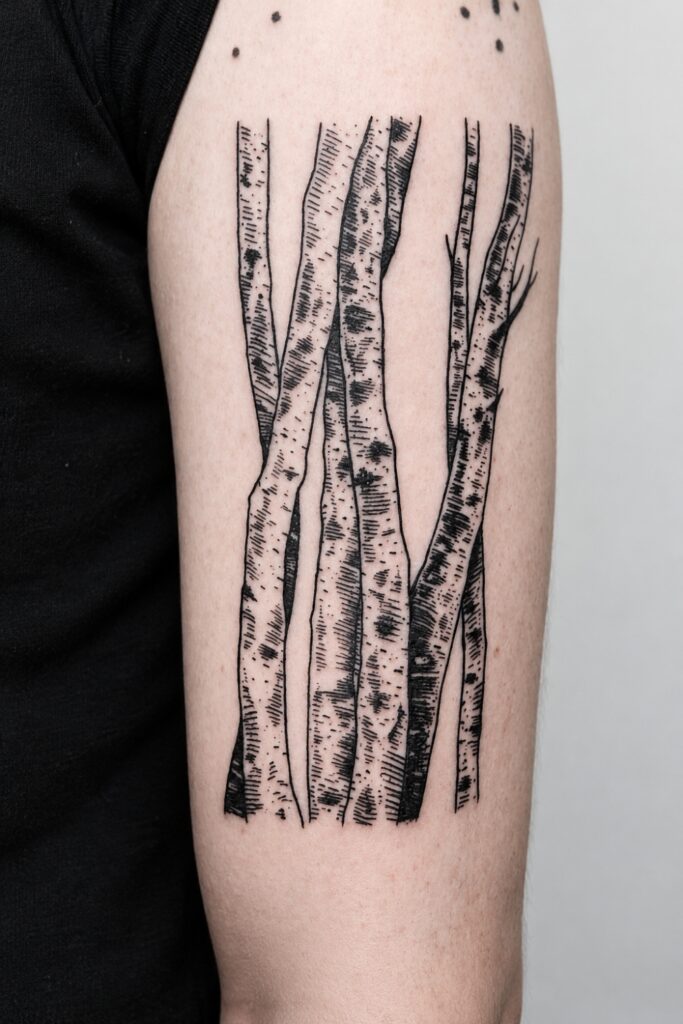
11. Birch Grove
Arrange three to five slender trunks with recognizable bark marks and sparse foliage. Vary spacing and width.
Birch is commonly associated with renewal and new beginnings in contemporary tattoo symbolism.
Best for: forearm, calf.
 Save
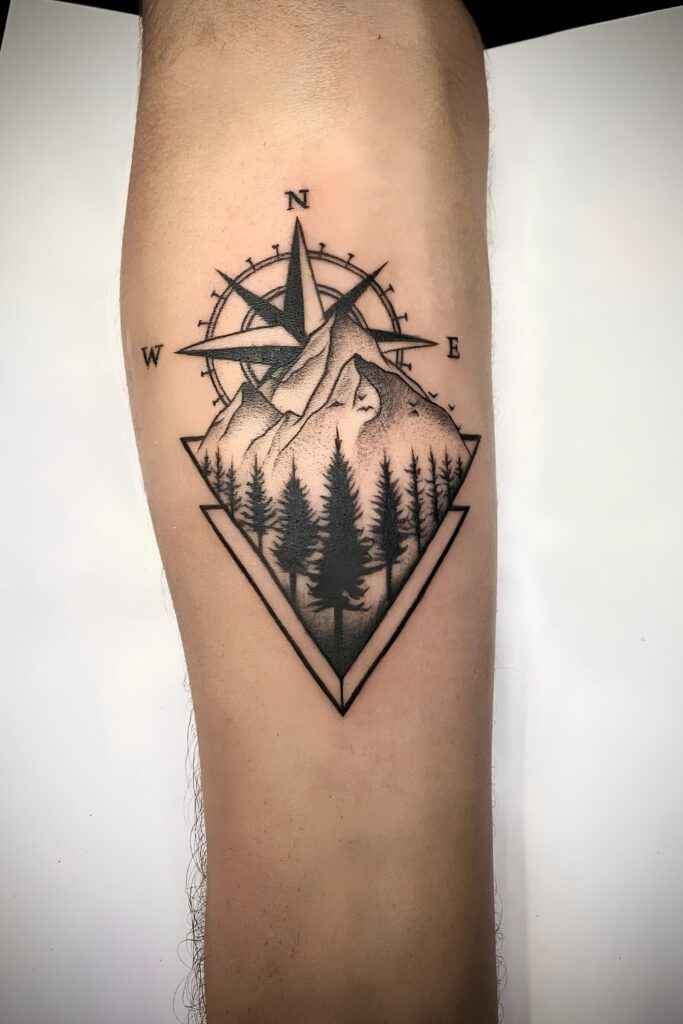
12. Tree + Compass Landscape
Integrate a strong tree with a simplified compass rose and mountain horizon. Keep the compass geometry readable.
The combination works well for stories about travel, home, direction, and grounding.
Best for: upper arm, calf, half sleeve.
 Save
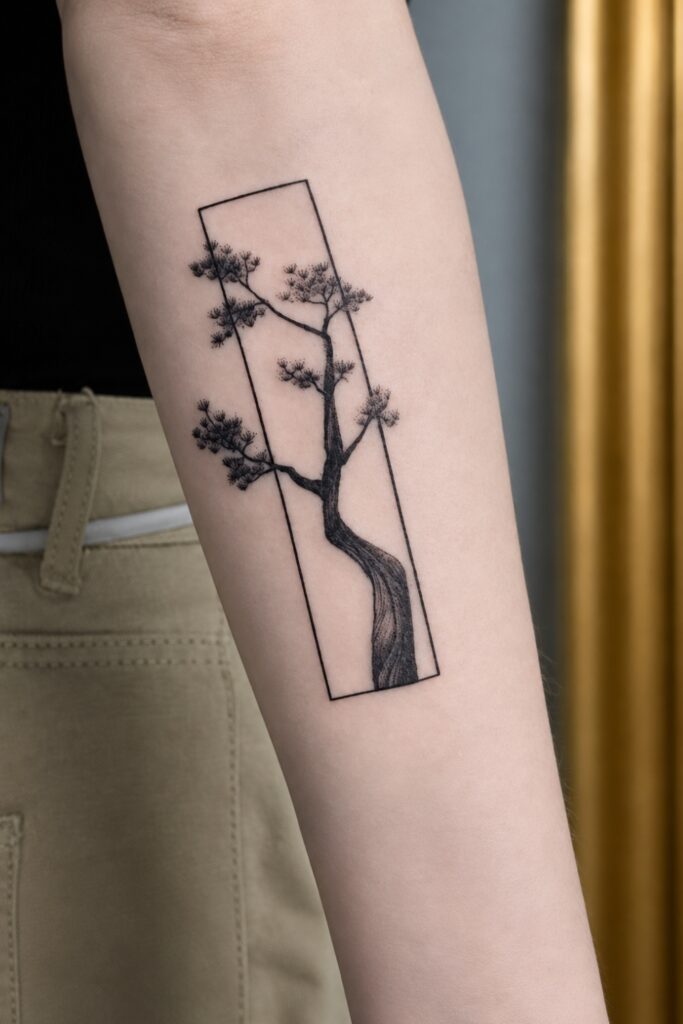
13. Japanese-Inspired Pine
Build a stylized windswept pine with strong black foliage masses and cloud or wind shapes. Keep it custom rather than copied.
Pine has a long visual history in Japanese art and benefits from generous scale and negative space.
Best for: upper arm, shoulder, thigh.
 Save
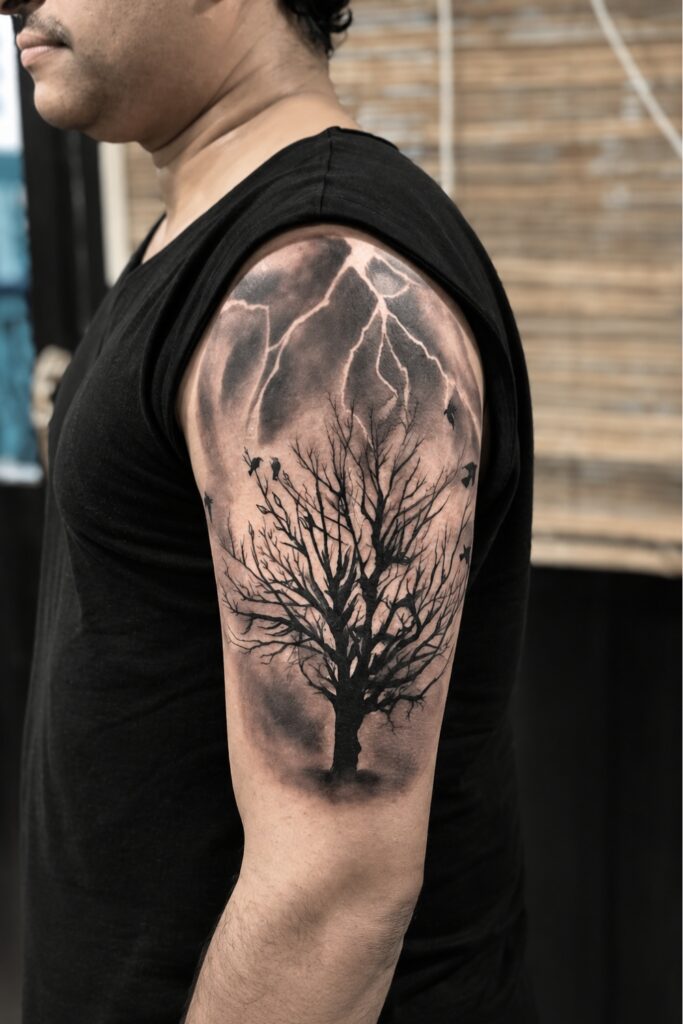
14. Lightning-Struck Tree
Use a split or scarred trunk with one surviving branch or small leaf cluster. Keep the damage stylized.
A damaged tree can represent survival, disruption, rebuilding, or a life divided into before and after.
Best for: chest, upper arm, calf.
 Save
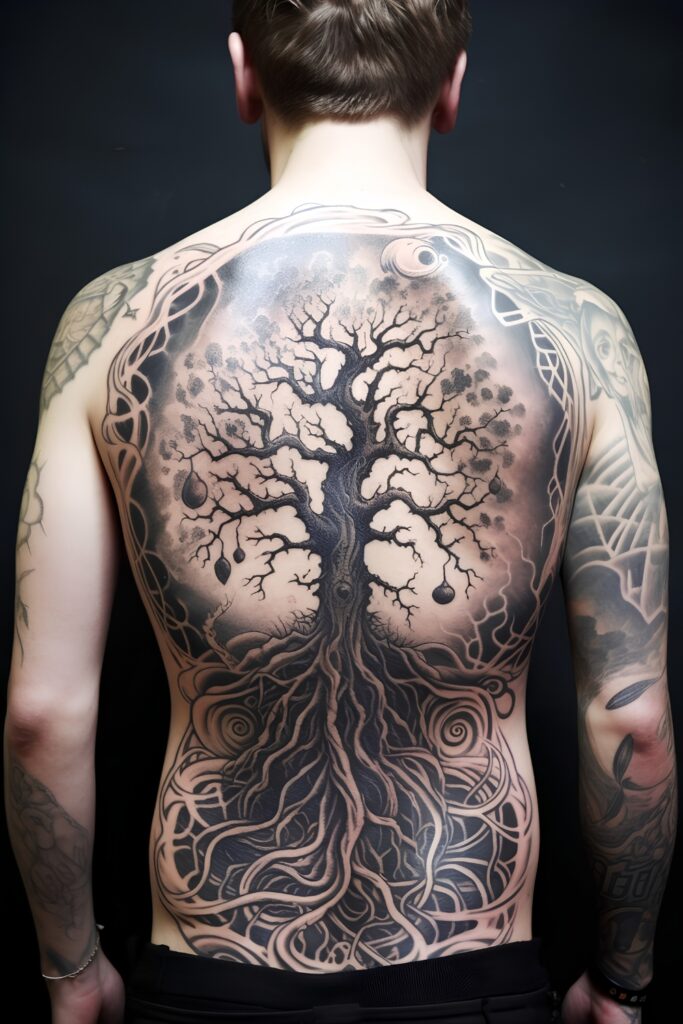
15. Ancient Tree Back Piece
Use the back for a large old tree with textured trunk, visible roots, and branch groups spreading toward the shoulders. Leave skin between major limbs.
Large trees need enough scale for roots, trunk, and canopy to remain separately readable.
Best for: full or upper back; realism or illustrative blackwork.
 Save
Quick Guide: Choose the Tree by Meaning and Shape
| Goal | Strong choices | Visual strength | Watch for |
| Strength / endurance | Oak, pine | Strong trunk/silhouette | Generic filler symbols |
| Roots / family | Exposed roots, tree rings | Foundation detail | Hair-thin root clutter |
| Change / survival | Bare, lightning-struck | Branch/trunk contrast | Assuming one fixed meaning |
| Nature / travel | Forest, compass landscape | Layered scenery | Crowded trunks |
| Balance / growth | Tree of Life, bonsai | Controlled composition | Tiny knotwork |
| Large statement | Willow, ancient tree | Canopy movement | Compressed detail |
What Do Tree Tattoos Mean for Men?
Tree tattoos commonly represent growth, resilience, stability, roots, family, time, or connection to nature. Species and condition change the interpretation.
These meanings are conventions, not rules. A tree from a childhood property or favorite hiking trail can carry a more specific personal meaning than any symbolism guide.
Choose the Species Before the Style
Oak gives you a heavy trunk and broad crown. Pine creates a narrow vertical silhouette. Willow depends on hanging branch movement. Birch works through repeated pale trunks. Bonsai concentrates age and structure into a compact form.
Once the species is chosen, decide whether realism, blackwork, fine line, geometric framing, traditional color, or Japanese-inspired composition best supports its shape.
How Much Detail Does a Tree Tattoo Need?
More detail is not automatically better. Fine twigs, needles, roots, and leaves need enough space between them to remain readable.
If the placement is small, simplify the canopy or choose a tree silhouette instead of shrinking a full realistic landscape.
Best Placements for Tree Tattoos on Guys
Forearms and calves suit pines, roots, geometric trees, and vertical landscapes. Upper arms and chests can support broader oaks and bare trees. Thighs, shoulder blades, and backs give willows, forests, and ancient trees room to spread.
Choose placement before finalizing the artwork because a calf composition and a chest composition need different branch structures.
Tattoo Safety and Aftercare
Choose a reputable professional artist who follows local hygiene and sterilization requirements. For detailed nature work, review healed examples of their trees, branches, gray wash, or fine lines before booking.
Follow your artist’s aftercare instructions. Seek medical care for concerning symptoms such as spreading redness, worsening swelling, pus, fever, or red streaking.
Relevant Fashionuer Guides
Half-sleeve tattoos for men: https://fashionuer.com/fashion/tattoos/half-sleeve-tattoos-for-men/
Halloween tattoos for guys: https://fashionuer.com/fashion/tattoos/halloween-tattoo-ideas-for-guys/
Thanksgiving tattoos for men: https://fashionuer.com/fashion/tattoos/thanksgiving-tattoos-for-men/
For more ideas, see our street-style neck tattoo ideas and what they mean, small christmas tattoo ideas that look stunning all year and thanksgiving tattoos for men, sorted by how well they age.
FAQ
What is the best tree tattoo for a guy?
There is no single best design. Oak, pine, exposed roots, forests, Tree of Life, bonsai, and bare trees all create different shapes and meanings. Choose the species around your story and placement.
What does an oak tree tattoo mean?
Oak tattoos are commonly associated with strength, endurance, stability, wisdom, and deep roots. Personal meaning can differ depending on why you chose the species.
What does a pine tree tattoo symbolize?
Pine tattoos are often linked with resilience, longevity, endurance, and connection to place because evergreen trees persist through difficult seasons.
What do tree roots symbolize in tattoos?
Roots commonly represent grounding, ancestry, family, home, foundation, or hidden strength. They can also simply be chosen for their visual structure.
Are tree tattoos good for forearms?
Yes. Pine trees, exposed roots, geometric trees, tree rings, and narrow landscapes naturally suit the forearm’s vertical shape.
What tree tattoo works for a large back piece?
Ancient spreading trees, willows, large oaks, Tree of Life compositions, and forest landscapes benefit from the back because branches and roots have room to expand.
Can tree tattoos be minimalist?
Yes. A single pine, tree-ring circle, small branch, simplified roots, or geometric tree can work with restrained linework and adequate spacing.
Should I get a realistic or blackwork tree tattoo?
Choose realism for bark, depth, and landscape detail; blackwork for stronger silhouette and contrast; fine line for simpler trees; and geometric work when structure matters more than naturalism.
The Silhouette Test
Shrink the reference on your screen or step several feet away from the stencil. Can you still tell whether it is an oak, pine, willow, bare tree, or forest without relying on tiny bark and leaf details?
If yes, the design has a strong foundation. A tree tattoo should work as a silhouette first and reward closer inspection with texture second.