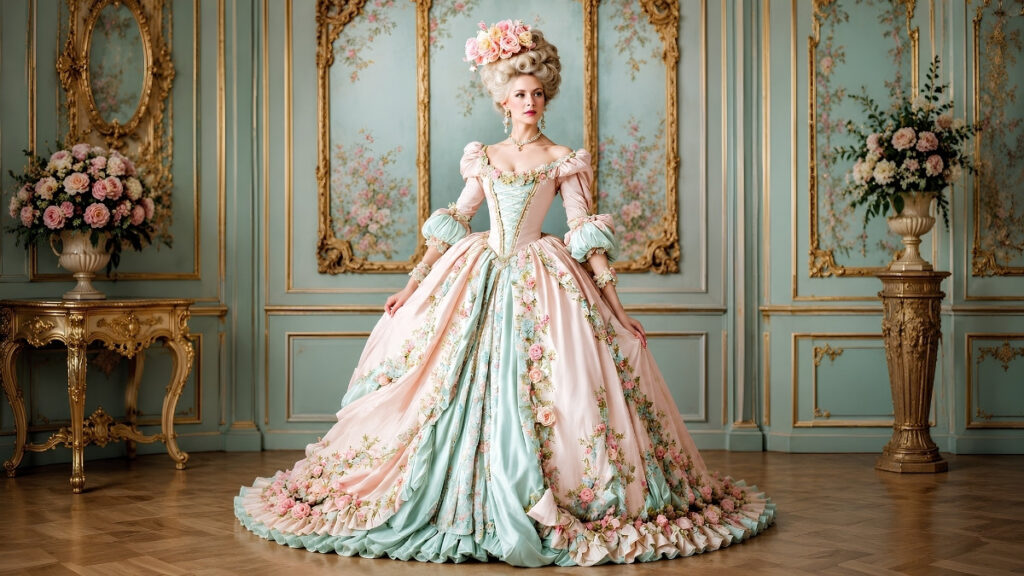
Rococo wedding dresses are one of the most-searched bridal aesthetics on Pinterest going into 2026. Wedding Style Magazine confirmed Kim Kassas Couture’s Spring 2026 collection as one of the most direct interpretations of Rococo-esque silhouettes on any bridal runway this season, with waist-cinching corsets in brocade and Solstiss lace, Basque waistlines, billowing sheer sleeves, and seemingly endless trains of silk.
Bridal designer Kim Kassas describes her approach as embracing excess in its most captivating form. That is the Rococo bridal philosophy in a single sentence. The 18th-century French aesthetic that defined the court of Versailles was built on asymmetry, ornament, soft curves, and the idea that a garment could itself be a work of art. In 2026, bridal fashion is referencing that vocabulary directly.
These 15 Rococo wedding dress ideas cover every silhouette, fabric, embellishment, and venue context for 2026, from the most historically referenced designs through to the modernised interpretations that make the aesthetic wearable for today’s bride.
What Defines a Rococo Wedding Dress
The Rococo period, spanning roughly 1720 to 1780 in France, produced fashion defined by three visual principles: extreme volume at the hip, extreme decoration at every surface, and extreme softness in the colour palette. The silhouette was built on the panniers, the side-extending understructure that pushed skirts outward at the hip while the front and back remained relatively flat.
A Rococo wedding dress in 2026 does not need to replicate all three principles literally. The most wearable interpretations take one or two: the Basque or dropped waist that narrows dramatically before the skirt expands, the brocade or floral embroidered fabric, the billowing sleeve, or the cascading silk train. Any one of these applied to a contemporary bridal silhouette produces the Rococo reference.
Bridal fashion historian and author Dr. Joanna Marschner, who has written extensively on 18th-century court dress and its influence on contemporary fashion, identifies the Rococo as the period when fashion became explicitly theatrical. Every gown was designed to be seen from the front across a room. That principle translates directly to a wedding ceremony.
Silhouette-First Rococo Wedding Dresses
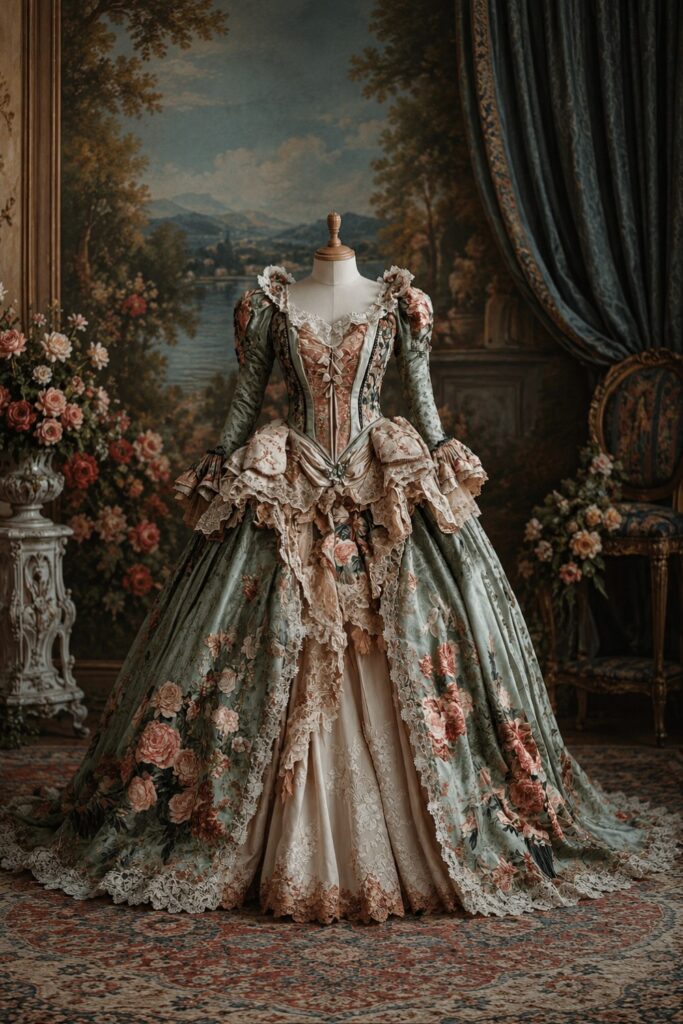
Brocade Corset with Cascading Silk Train
A structured brocade bodice with a corset boning silhouette, the brocade in ivory, champagne, or a soft rose gold, with a full cascading silk train that begins at the natural or Basque waist. Kim Kassas Couture’s Spring 2026 collection produced the most widely referenced version of this exact combination.
Brocade in a wedding dress context is the fabric choice that most directly communicates the Rococo aesthetic without requiring any additional embellishment. The woven pattern in the fabric itself provides the surface ornament. A heavy duchess satin or a plain taffeta in the same silhouette reads as formal. The same silhouette in brocade reads as specifically Rococo.
Choose a silk brocade rather than a polyester brocade. The way a silk brocade moves and photographs in natural venue light is categorically different from a synthetic version. The raised woven pattern catches daylight with a dimensional quality that synthetic brocade cannot replicate.
 Save
Basque Waist Ballgown with Panniers
A Basque waistline that dips to a V or a deep point at the front and back before the skirt extends outward from the hip in a volume that references the 18th-century pannier silhouette, the fullness concentrated at the sides rather than evenly distributed all around.
Wedding Style Magazine confirmed the Basque waistline as a defining Spring 2026 bridal detail across multiple collections. The drop at the front of the Basque waist elongates the torso visually, which is the proportional effect that makes this silhouette so photographically powerful at a ceremony. The side volume references the Rococo pannier without requiring a literal understructure.
Monique Lhuillier presented its Spring 2026 collection in the Louis XIV room at the St Regis, a deliberate setting choice that placed the gowns in their most appropriate architectural context. The room and the gowns were in direct visual dialogue.
 Save
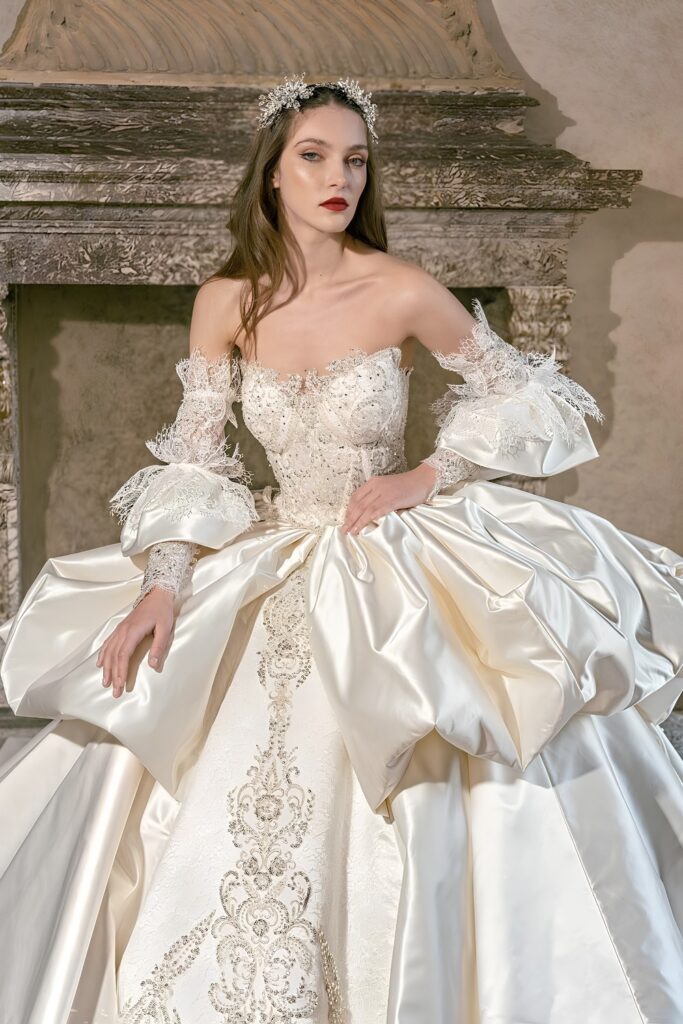
Off-Shoulder Draped Bodice with Full Skirt
An off-shoulder neckline with a draped fabric that sweeps from one shoulder across the bodice, falling into a full tulle or silk skirt at the waist. Elie Saab’s Spring 2026 collection produced multiple versions of this draped, sculptural approach confirmed by Wedding Style Magazine as one of the strongest Rococo-adjacent silhouettes of the season.
The off-shoulder sweep of fabric across a structured bodice is the single gesture that most immediately references 18th-century portraiture, specifically the draped sash that appears in formal portraits by Vigée Le Brun and Gainsborough. The gesture reads as historically aware without requiring any period-specific research from the viewer.
For the full-volume and puff skirt silhouettes that sit alongside the draped bodice and ballgown options in the Rococo bridal aesthetic, the puff skirt outfits guide covers the structured and voluminous skirt approaches that define the dramatic occasion dressing which forms the aesthetic foundation of the Rococo wedding dress silhouette.
 Save
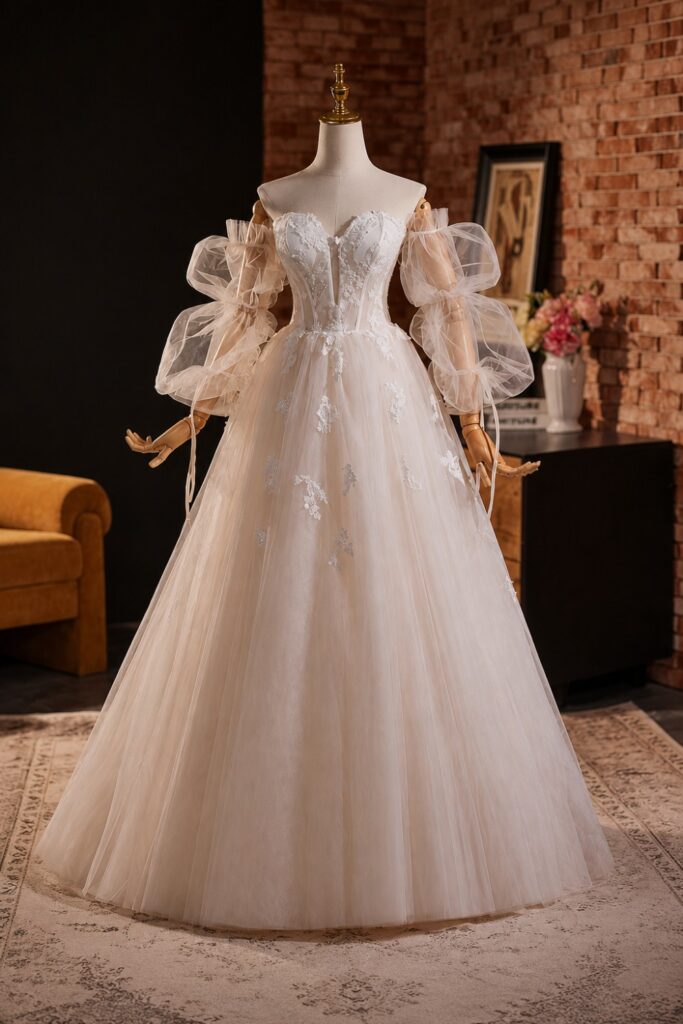
Billowing Sheer Sleeve Gown
A fitted or structured bodice with detachable or fixed billowing sheer sleeves at the upper arm, the sleeve volume concentrated between the shoulder and the elbow and tapering to a fitted or open cuff below. Wedding Style Magazine specifically named billowing sheer sleeves as a defining embellishment in Kim Kassas Couture’s Rococo-esque Spring 2026 collection.
The billowing sleeve in a sheer fabric, organza or silk chiffon, adds the most volume of any sleeve direction while adding the least physical weight. The sleeve catches movement as you walk, creating the kind of visual drama that photographs with architectural quality from any distance across a ceremony venue.
Maggie Sottero’s Fall 2026 Lost in Reverie collection includes detachable puff sleeves described by their creative team as making the gown larger than life. Detachable sleeves allow the ceremony silhouette to differ from the reception silhouette using the same gown.
 Save
Embellishment-Led Rococo Wedding Dresses
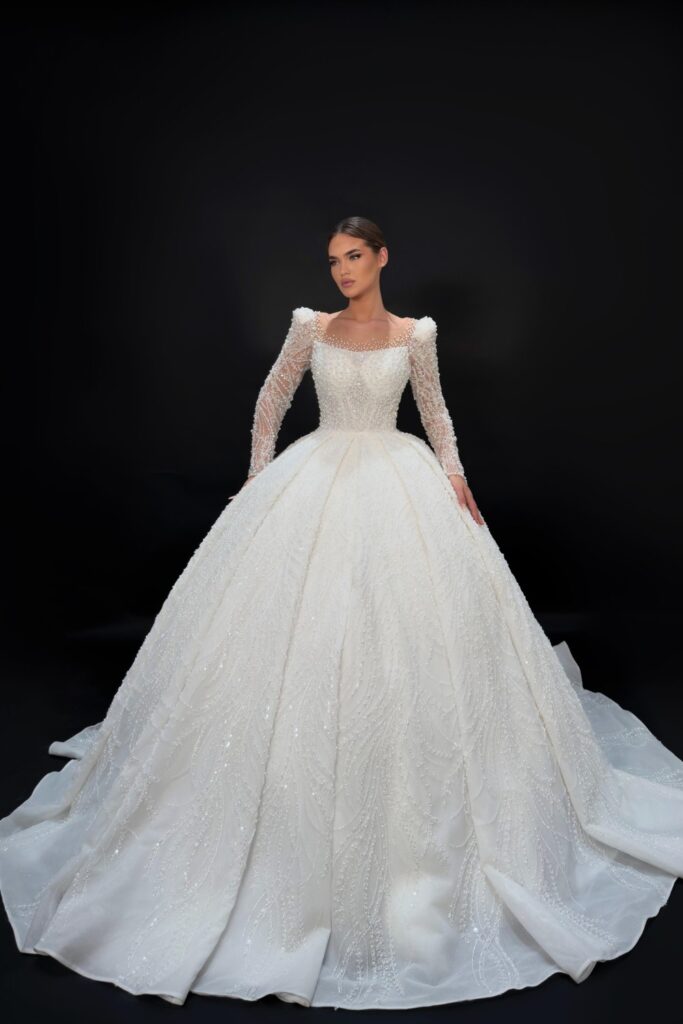
Crystal and Pearl Encrusted Ballgown
A full ballgown silhouette with crystal and pearl embellishment across the bodice and upper skirt, the stones applied in a pattern that concentrates decoration at the bodice and thins out as it falls toward the hem. Kim Kassas Couture’s Spring 2026 collection used crystal and pearl embellishments in exactly this distribution.
Rococo decoration never distributes itself evenly. The historical aesthetic concentrated the most ornament at the point closest to the face, the bodice and neckline, and reduced it gradually toward the hem. A gown with equal embellishment from bodice to train reads as maximalist rather than specifically Rococo. The gradient distribution from heavy to light is the period-specific design principle.
 Save
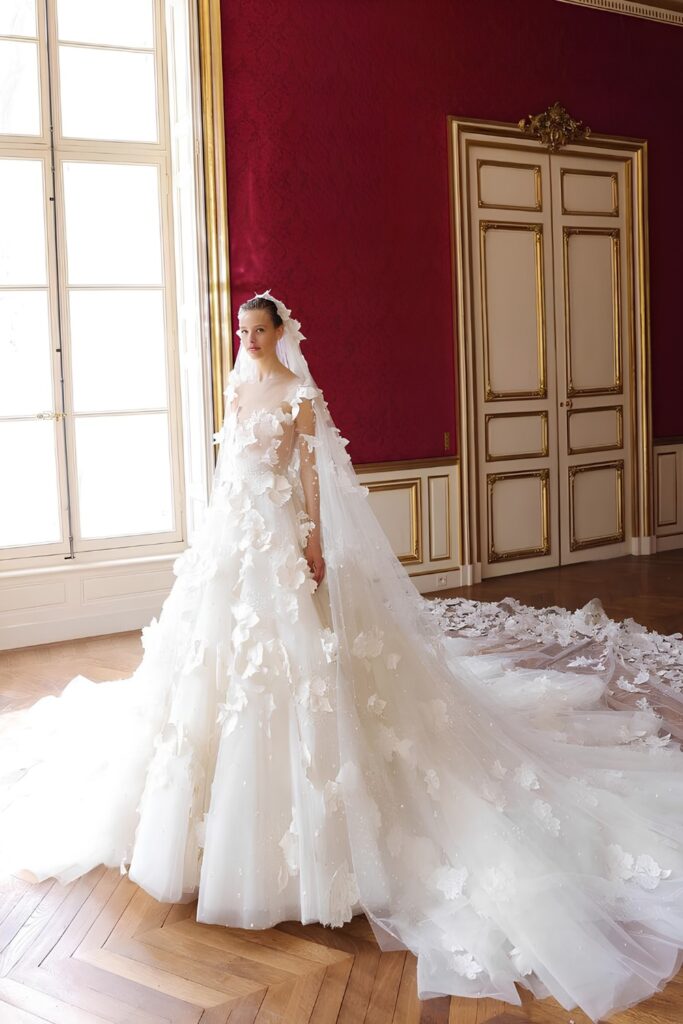
3D Floral Appliqué Gown
A structured or softly draped gown with dimensional floral appliqués applied across the bodice and skirt, the flowers in ivory, blush, or a soft champagne, each bloom sitting above the fabric surface in a three-dimensional structure. Gavin Christianson Bridal confirmed 3D floral appliqués as one of the defining 2026 bridal details.
Maggie Sottero’s Amaryllis gown from the Fall 2026 Lost in Reverie collection uses this approach most dramatically, with deep forest green beaded leaves, soft lavender embroidery, and oversized ivory 3D blooms across a structured corset bodice. The individual bloom colours create the palette diversity that Rococo decorative arts consistently employed.
 Save
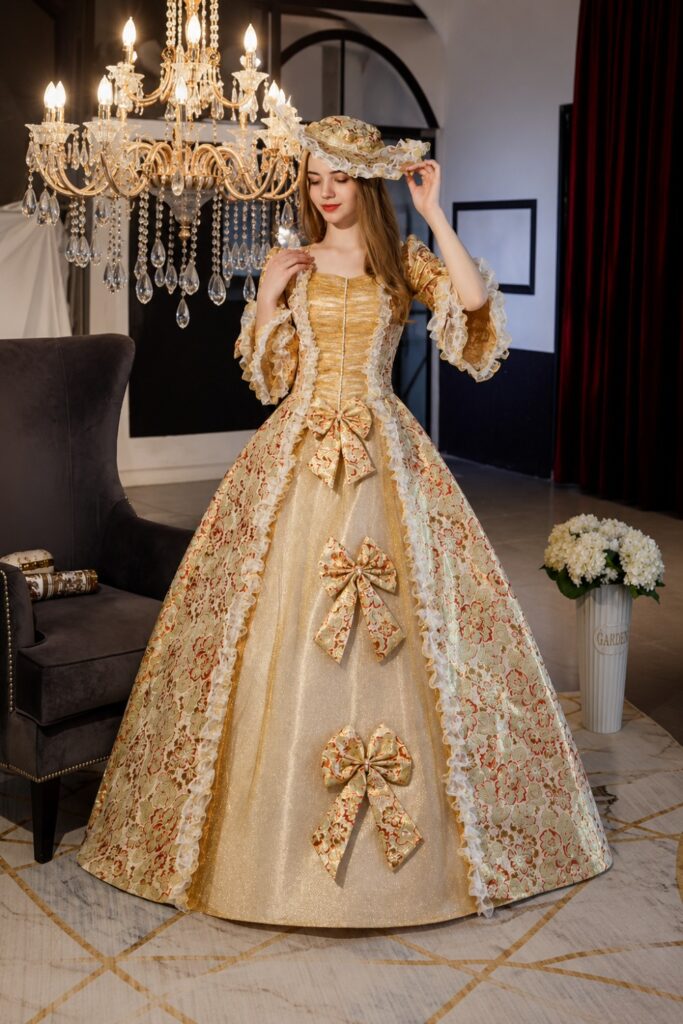
Embroidered Brocade with Chandelier Crystal Trim
A gown in embroidered brocade, the pattern woven into the fabric rather than appliquéd over it, with chandelier crystal trim at the neckline, cuffs, and hem edge. Maggie Sottero’s Fall 2026 collection described chandelier-crystal glamour as one of its central embellishment directions.
Chandelier crystals at the hem of a wedding gown catch the light with every step, which means the most dramatic visual moment of this gown is the bride walking. The crystals swing at the hem as the fabric moves and photograph under venue lighting as a cascading glow at the base of the dress. The brocade above stays structured while the hem animates the entire silhouette.
 Save
Pearl-Trimmed Drama Gown
A structured gown with pearl trim applied at the neckline, sleeve edge, and waistline, the pearls running in a single or double row at each structural seam of the gown rather than scattered across the surface. Maggie Sottero specifically named pearl-trimmed drama as one of the Fall 2026 collection’s lead embellishment directions.
Pearl trim at the structural seams of a gown is the embellishment approach that most directly references 18th-century court dress, where passementerie, braid and trim applied at the seam lines, was the primary decorative element. A row of pearls at the neckline edge and the waistline seam of a structured bodice communicates that specific vocabulary with a single design decision.
 Save
Modern Rococo Wedding Dress Interpretations
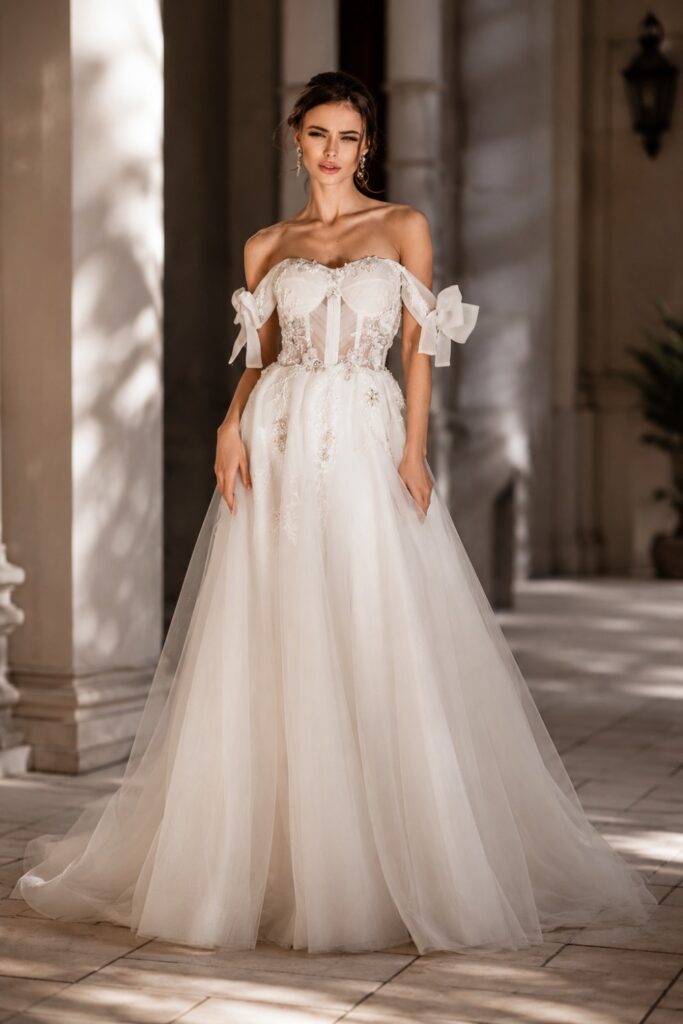
WED Collection Visible Boning with Flattened Bows
A structured tulle gown with exposed boning visible through the fabric and flattened satin bows applied across the skirt at intervals, the construction of the gown made part of its surface decoration. Who What Wear April 2026 described WED’s 2026 collection as less period drama, more Margot Robbie’s Catherine.
Visible boning in a wedding gown is the 2026 update to the Rococo structural transparency principle. 18th-century court gowns showed their construction through the elaborate pleating and seam work on the exterior. A modern bridal gown with intentionally visible boning makes the same statement: the structure is not hidden, it is the design.
 Save
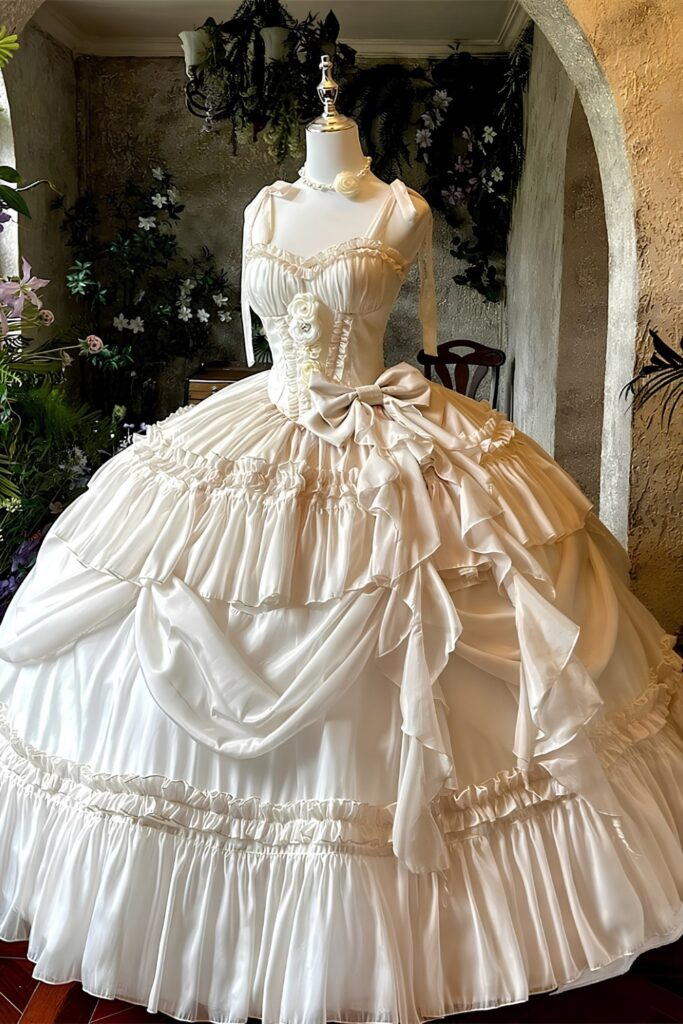
Corset Bodice with Tiered Silk Skirt
A long-line exposed corset bodice in ivory or champagne, the boning channels visible and deliberate, with a tiered silk or silk-chiffon skirt that layers into a full silhouette at the hem. The Knot confirmed long-line and exposed corsetry as one of the bridal directions appearing across multiple Spring-Summer 2027 collections previewed at NYBFW in April 2026.
The long-line corset that extends below the natural waist and onto the hip is the silhouette update that connects the Rococo bodice to the contemporary bridal vocabulary. It elongates the torso in the same way a Basque waist does but with a more explicit structural statement. The tiered skirt below adds the volume that the fitted corset above requires as a counterweight.
 Save
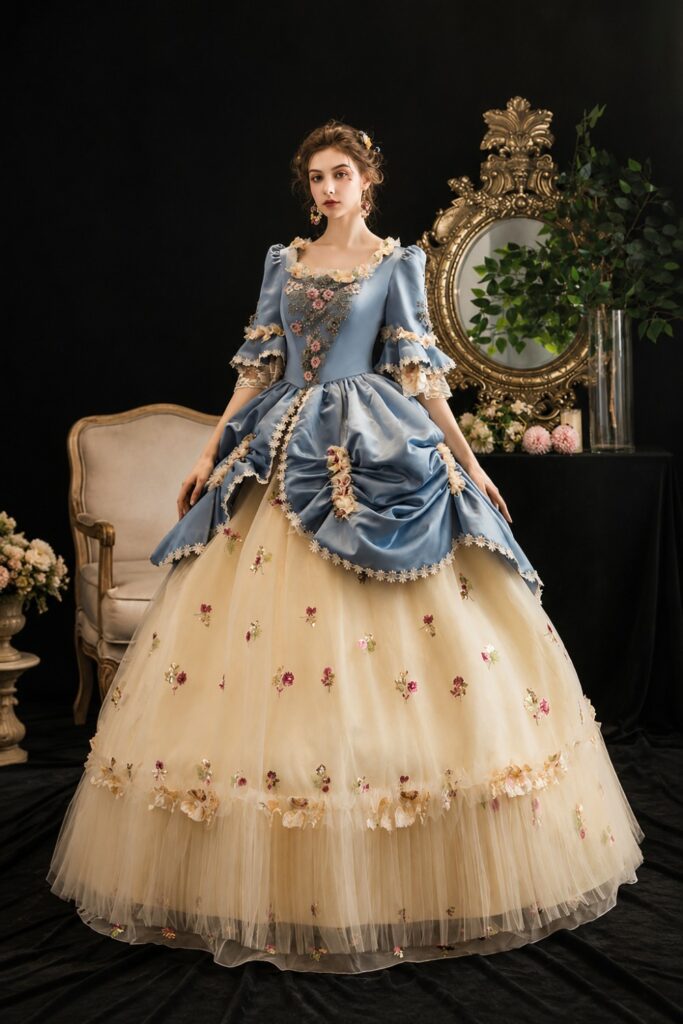
Multicoloured Rococo Gown
A Rococo-inspired gown in a non-white colourway, incorporating soft blush, lavender, and champagne into the embroidery or appliqué, with an ivory or soft white base. Maggie Sottero’s Amaryllis gown confirmed multicoloured bridalwear as a legitimate 2026 direction, with forest green, lavender, and ivory combined in a single gown.
Rococo fashion was never restricted to white or ivory. The 18th-century palette included soft powder blue, blush rose, pale gold, and sage green as primary gown colours. A wedding gown that incorporates colour through its embroidery or appliqué while maintaining a white or ivory base communicates the Rococo palette without committing the bride to a fully coloured gown.
 Save
Mantilla Veil with Lace-Trimmed Ballgown
A full ballgown in lace or lace-trimmed silk with a mantilla veil, the veil’s lace edge matching or complementing the gown’s lace, the ensemble photographing as a single composed silhouette from every angle at the ceremony. The Knot confirmed mantilla veils as one of the top bridal accessories directions for 2026 and 2027.
The mantilla veil is the most historically correct Rococo bridal accessory. 18th-century court dress combined elaborate lace at the neckline and cuffs with lace or silk veiling at the head. A contemporary bride in a ballgown with a mantilla veil references that complete vocabulary without any single piece looking costumed in isolation.
 Save
Venue-Specific Rococo Wedding Dress Ideas
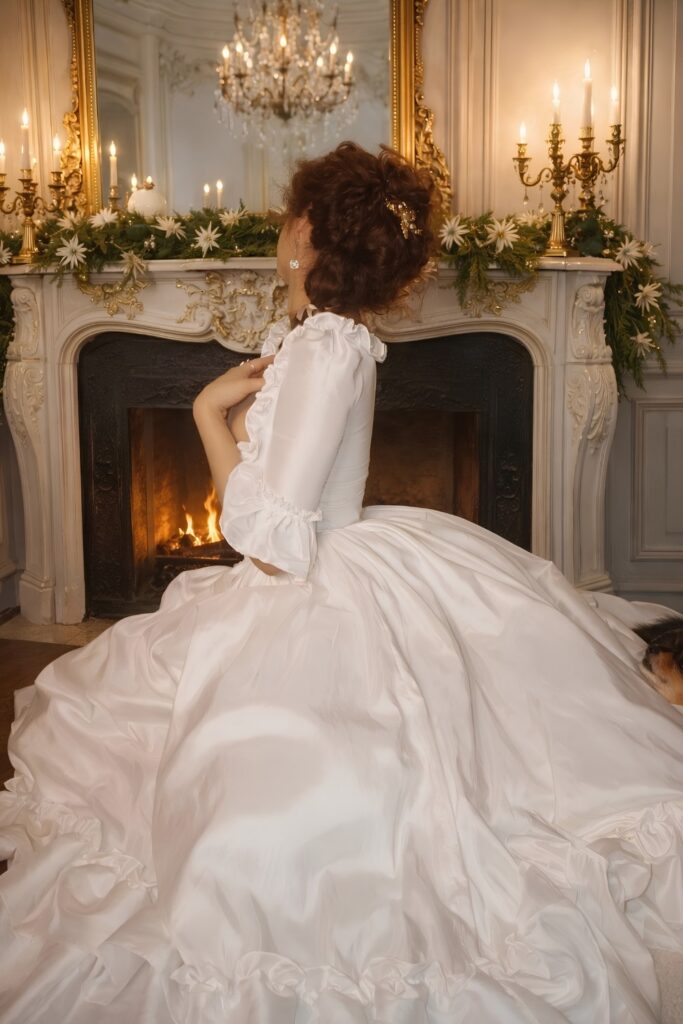
Candlelit Indoor Ceremony: Velvet and Silk Combination
A gown combining velvet at the bodice with a silk or silk-chiffon skirt, the velvet absorbing candlelight with a deep, textural richness and the silk skirt catching and reflecting it below. Maggie Sottero’s Fall 2026 Lost in Reverie collection was designed specifically for candlelit ceremony spaces, with velvet shadows and candlelit shimmer as the stated creative brief.
Velvet at the bodice of a wedding gown photographs under warm candlelight with a depth that no other bridal fabric can replicate. The nap of the velvet catches the light from different angles simultaneously, which means the bodice reads as luminous even in low light. Below the waist, silk chiffon moves and catches the candlelight differently, creating the textural contrast that Rococo design always exploited between surfaces.
For the formal and structured gown aesthetic that positions the Rococo wedding dress within its broader heritage of powerful occasion dressing, the Princess Diana outfits guide covers the most significant structured and formal gown moments in recent fashion history, including the architectural silhouettes and couture embellishments that directly informed the Rococo revival in 2026 bridal design.
 Save
Garden and Outdoor Wedding: Organza with Floral Embroidery
A light, flowing gown in organza or silk chiffon with botanical floral embroidery across the bodice and skirt, the embroidery in a palette of ivory, blush, and sage, the overall silhouette deliberately lighter than a structured ballgown to suit outdoor garden wedding venues.
Maggie Sottero’s Fern gown from Fall 2026 addresses exactly this context, described by their creative team as botanical and alive, with embellishment that feels like it grew there naturally. An outdoor Rococo wedding gown should move with the breeze rather than resist it. The heavier structured silhouettes suit indoor venues with controlled environments. Organza and silk chiffon with botanical embroidery suit open-air settings where the fabric’s movement adds to the visual.
 Save
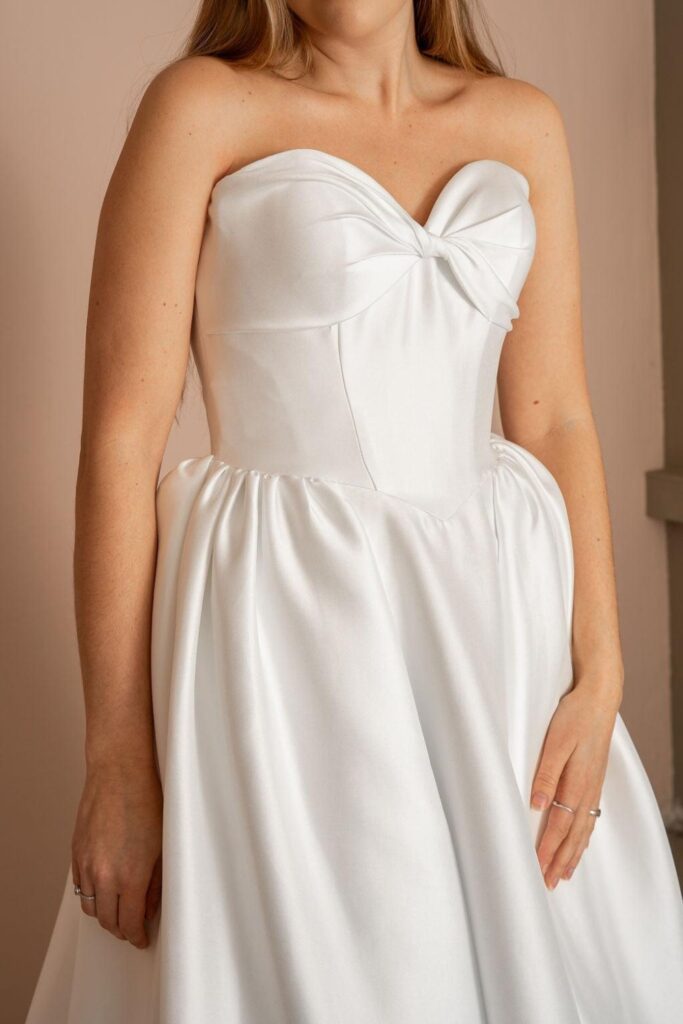
Contemporary Venue: Minimalist Rococo with Micro Bows
A clean, structured gown in a refined silhouette with micro bow details placed at the back waist, shoulder, or along the sleeve edge, the bows adding the Rococo ornament reference without committing to a full ballgown volume. The Knot confirmed micro bows as one of the top bridal details at NYBFW Spring-Summer 2027 previews in April 2026.
Micro bows are the Rococo decorative vocabulary distilled to its smallest, most contemporary unit. The 18th-century obsession with ribbons and bows at every structural seam and decorative point of a gown becomes, in 2026, a single small bow at the back waist of an otherwise minimal dress. The reference is present. The silhouette remains contemporary. For brides who want the Rococo reference without the full theatrical commitment, this is the starting point.
For the bridal beauty and skincare preparation that gives your complexion the most luminous, photograph-ready quality to complement a Rococo wedding gown, fashionuer’s beauty tips covers the skin prep, SPF, and finishing routines that ensure your face photographs as beautifully as the gown in every ceremony and reception image.
 Save
Rococo Bridal Accessories
A mantilla veil in Chantilly or Solstiss lace is the most historically accurate Rococo bridal accessory and the one most frequently paired with full ballgown silhouettes in the 2026 bridal collections. The veil should be long enough to extend beyond the train of the gown when the bride stands at the altar.
Pearl jewellery, specifically a statement pearl necklace or a pearl and crystal collar, completes the Rococo reference at the neckline. The pearls should be the same tone as the gown, warm ivory pearls against a champagne or brocade gown, cool white pearls against a pure white or organza gown. Mismatched pearl tone and gown tone reads as two different colour stories competing at the face.
Hair accessories for a Rococo wedding dress should reference the same decorative vocabulary as the gown. A crystal or pearl-studded headband, a floral crown in silk or fresh flowers, or a mantilla comb at the crown are the three most appropriate choices. Avoid minimalist geometric hair accessories, which belong to a different aesthetic vocabulary entirely.
Frequently Asked Questions
What is a Rococo wedding dress?
A Rococo wedding dress references the 18th-century French court aesthetic defined by extreme hip volume from the pannier understructure, intense surface decoration through embroidery, brocade and embellishment, and a soft romantic colour palette. In 2026, Kim Kassas Couture, Elie Saab, Monique Lhuillier, and Maggie Sottero all produced collections with Rococo-esque silhouettes confirmed by Wedding Style Magazine and other bridal publications. A contemporary Rococo wedding dress takes one or two of these principles, a brocade fabric, a Basque waist, a billowing sleeve, or cascading embellishment, rather than replicating all of them literally.
Are Rococo wedding dresses trending in 2026?
Yes. Wedding Style Magazine confirmed Kim Kassas Couture’s Spring 2026 collection as producing Rococo-esque silhouettes with brocade fabrics, Basque waistlines, and billowing sheer sleeves. Maggie Sottero’s Fall 2026 Lost in Reverie collection references the Rococo aesthetic through velvet and silk combinations, chandelier crystals, pearl trim, and 3D florals. The Knot confirmed at NYBFW April 2026 that Basque-drop waist hybrids, mantilla veils, exposed corsetry, and micro bows, all Rococo-adjacent details, are among the top bridal directions for 2026 and 2027.
What fabrics are used in Rococo wedding dresses?
Silk brocade, Solstiss lace, duchess satin, silk chiffon, organza, and velvet are the fabrics most associated with the Rococo bridal aesthetic in 2026. Kim Kassas Couture specifically used Solstiss lace alongside brocade in their Spring 2026 Rococo-esque collection. Brocade is the most historically specific fabric choice because the woven pattern provides the surface decoration without requiring appliqué. Velvet suits indoor candlelit ceremony venues specifically, as confirmed by Maggie Sottero’s Fall 2026 creative direction for the Lost in Reverie collection.
What silhouette defines a Rococo wedding dress?
The Basque or dropped waist that dips to a V at the front before the skirt expands, the full ballgown with side volume referencing the historical pannier, and the off-shoulder draped bodice with a full skirt are the three silhouettes most directly associated with the Rococo aesthetic in 2026 bridal fashion. Wedding Style Magazine confirmed all three as appearing in Spring 2026 collections. Bridal fashion historian Dr. Joanna Marschner identifies the Rococo as the period when fashion became explicitly theatrical, designed to be seen from across a room, which is a principle that translates directly to a wedding ceremony.
How do you accessorise a Rococo wedding dress?
A mantilla veil in Chantilly or Solstiss lace is the most historically appropriate Rococo bridal accessory and the one confirmed by The Knot as one of the top 2026 and 2027 bridal accessory directions. Pearl jewellery at the neckline in a tone matching the gown, a crystal or pearl-studded headband or floral crown, and long gloves in silk or kid leather complete the Rococo bridal vocabulary. Avoid minimalist geometric accessories, which sit in a different aesthetic context and compete rather than complement the decorative language of a full Rococo gown.
Final Thoughts
Rococo wedding dresses in 2026 offer the bride who wants ceremony-level drama a historically grounded aesthetic that bridal designers are actively producing rather than recreating from scratch. Kim Kassas Couture, Elie Saab, Maggie Sottero, Monique Lhuillier, and WED have all produced Rococo-adjacent collections this season.
Start with the brocade corset and silk train if you want the most directly Rococo result. Choose the micro bow minimalist interpretation if you want the reference without the full theatrical commitment. The billowing sheer sleeve is the single addition that moves any contemporary bridal gown closest to the Rococo aesthetic with the least structural complexity.