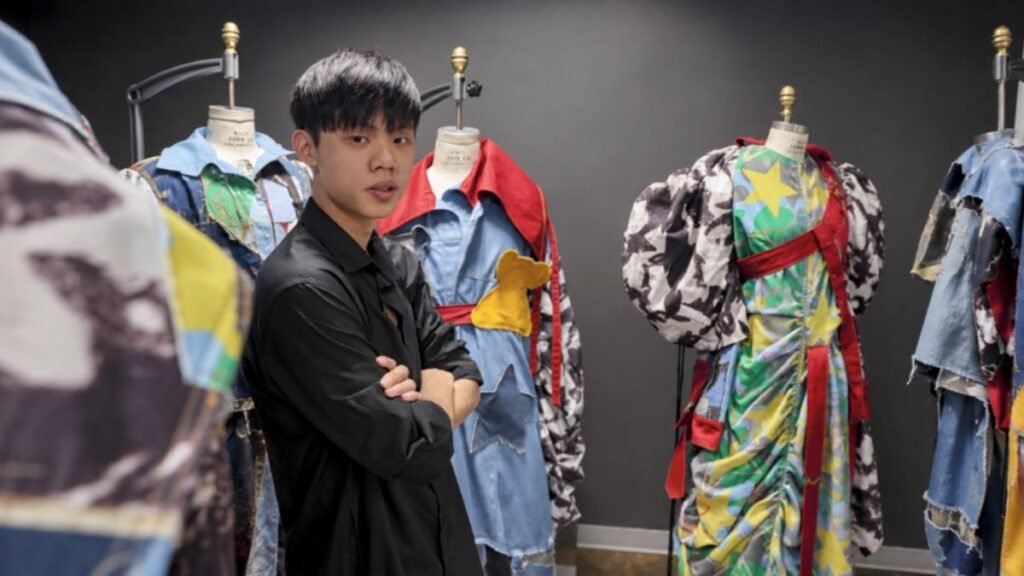
Taiwanese menswear designer Isaac Yu, based in Atlanta, Georgia, has built the independent label ISAAC around a design language that is both personal and materially adventurous. Specializing in denim and streetwear, he brings experimental construction, bold silhouettes, and the interplay between American and Asian menswear traditions into garments shaped by memory, identity, and function.
His collection Who Kills My Freedom? began with a difficult period in his life: the pressure and loss of autonomy he experienced during compulsory military service in Taiwan, and the childhood memories that helped him hold on to imagination and hope. Yu translates that tension between freedom and control through denim patchwork, reconstructed camouflage, crayon-like surfaces, deliberately imperfect stitching, and functional details shaped like teddy bears, dinosaurs, and stars.
The collection received Platinum at the 2025 London Design Awards; Gold at the 2025 MUSE Design Awards, 2025 MUSE Creative Awards, and 2026 French Design Awards; and recognition from the Red Dot Design Concept Awards. Yu was also selected to serve as a Fashion Design jury member for the 2026 London Design Awards, where he was entrusted with evaluating the work of other designers.
 Save
SaveFrom Drawing and Streetwear to a Personal Menswear Language
Fashionuer Isaac, what experiences and influences have shaped your design language and your focus on menswear and streetwear?
Isaac Yu Drawing and visual art have long been central to how I think creatively. Streetwear became especially important to me because it combines identity, culture, construction, and everyday function. Over the past eight years, that long-standing engagement has formed the foundation of my focused menswear practice, using streetwear as a framework for exploring narrative, memory, and personal freedom.
My background in drawing and long-standing engagement with streetwear remain central to the visual vocabulary I use today. They continue to inform how I approach proportion, surface treatment, color, and storytelling across my work.
Fashionuer What inspired you to create your acclaimed collection, Who Kills My Freedom?
Isaac Yu I am originally from Taiwan, where I was required to serve in the military. During my military service, I experienced depression and a great deal of pressure from losing my sense of freedom. The one thing that helped me stay positive was my nostalgia for childhood memories. Those memories allowed me to step away mentally from the reality of being controlled and return to a time when I felt free to imagine and create.
After completing my military service, I wanted to express this experience through fashion. I began designing a collection that tells the story of moving from restriction to freedom. Through this collection, I want to convey the message that everyone should follow their heart and pursue their freedom. No matter what obstacles or people try to hold you back, never let anyone stop you from dreaming.
 Save
SaveFashionuer What drew you to explore the intersection of children’s art and collage within fashion?
Isaac Yu I have always found something fascinating about children’s art: there is no right or wrong, and much of it is impossible to replicate. The style of children’s art expresses the most truthful and authentic side of human imagination, which makes it feel pure and creative. Its aesthetics have given me a great deal of inspiration and encouraged me to explore different ideas.
Fashion is similarly a form of storytelling that requires us to continually create and construct original narratives. I therefore decided to incorporate the aesthetics of children’s art into my designs, using its purity, spontaneity, and creativity to express the timeless and enduring nature of fashion.
International Visibility and Recognition
Fashionuer How did international runway exposure and coverage by Vogue Runway affect the visibility of your work?
Isaac Yu In 2025, my work was presented on the runway before an international audience of fashion professionals. A few days later, the collection was featured on Vogue Runway, extending its visibility to a global audience. Having the collection presented both in a live industry setting and on an international fashion platform demonstrated that the work could communicate beyond a single venue and reach audiences across markets.
Fashionuer Your work has received honors from the MUSE Design Awards, MUSE Creative Awards, London Design Awards, and French Design Awards, as well as recognition from the Red Dot Design Concept Awards. What do these achievements mean to you, and what do they demonstrate about the international reception of your work?
Isaac Yu I am truly grateful to the awards and judges who recognized my work. Their recognition confirmed that my creative vision and design practice had been evaluated and acknowledged by professionals in the international art and fashion industries. Receiving honors across multiple international competitions also reinforced the consistency of the ideas, craftsmanship, and visual language behind my work.
These distinctions expanded the visibility of my work across fashion and broader design communities and strengthened public recognition of both my label and my identity as a designer. Taken together, they represent independent recognition from multiple international platforms rather than a single, isolated honor.
Constructing Camouflage, Memory, and Imperfection
Fashionuer Patchwork is an important element of your design language. What makes your approach unique compared with what we typically see in contemporary fashion?
Isaac Yu I would say that my patchwork creations carry a stronger sense of storytelling and produce a distinctive visual effect. Rather than using patchwork solely as a technique to communicate sustainability, I wanted to explore its emotional and artistic meaning as well.
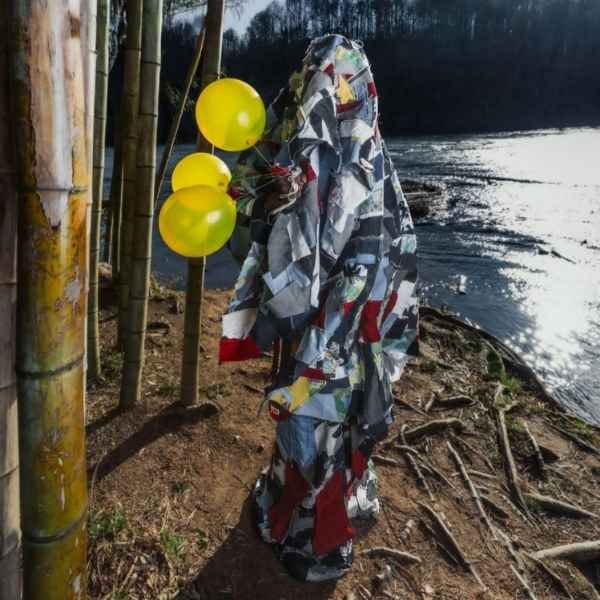
The concept was originally inspired by the aesthetics of children’s collages. I incorporated crayon drawings onto the surface of the patchwork and intentionally kept the details and stitching imperfect. This approach reflects the idea of imperfect craftsmanship and embraces the spirit of having no right or wrong, which I find so expressive in children’s art. Through these choices, I aim to celebrate spontaneity, individuality, and the beauty of imperfection while giving discarded denim a distinctive expressive role.
Fashionuer One of your recognized designs features a camouflage pattern created entirely through denim patchwork, an approach rarely seen in fashion. Why construct the camouflage through patchwork instead of using traditional fabric-printing techniques?
Isaac Yu The idea was deeply inspired by the aesthetics of children’s collages and the patchwork I had previously explored. I began to question how I could challenge the conventional stereotype of camouflage prints and reinterpret the familiar pattern through a different construction approach.
I studied the complex structures and visual characteristics of traditional camouflage patterns, then simplified their overall shapes and transformed them into small pieces of discarded denim. By layering the individual pieces one on top of another, the fragments gradually came together to form a recognizable camouflage pattern. This process allowed me to reinterpret a familiar visual language through an unconventional material and construction technique. Ultimately, the layered denim created a three-dimensional visual effect, adding depth, texture, and a sense of movement to the design.
Fashionuer Among the competitions and awards you have received, which honors mean the most to you, and why?
Isaac Yu Winning Gold in both the MUSE Design Awards and the MUSE Creative Awards is especially meaningful to me because each recognized the collection at an international level. Receiving Gold from two separate competitions provided external validation of the creative vision, construction, and storytelling behind the work. That recognition also placed the collection within a broader international design context and reinforced the distinctiveness of my practice.
Fashionuer How has the recognition surrounding Who Kills My Freedom? shaped the design language and identity of your label?
Isaac Yu The success of Who Kills My Freedom? established children’s collage, camouflage patchwork, and transformed functional details as recognizable elements of my work. The details include unconventional functional forms: stars, teddy bears, and dinosaurs become distinctive pocket shapes rather than remaining purely decorative motifs.
I do not treat these ideas as temporary motifs. I see them as part of a consistent design vocabulary that connects my conceptual interests with the visual identity of the label. Their repeated use gives audiences a clearer understanding of the principles, craftsmanship, and perspective associated with Isaac Yu.
Professional Recognition as a Fashion Design Jury Member
Fashionuer Your selection as a jury member for the Fashion Design category at the 2026 London Design Awards placed you in a formal role evaluating other designers. What did this responsibility mean to you personally and professionally?
Isaac Yu Serving as a judge for the 2026 London Design Awards was meaningful because it placed me in a formal role evaluating the work of designers from around the world. Throughout the judging process, I approached each submission with an open mind, considered the designer’s intentions, and evaluated the work as fairly and objectively as possible.
The role required me to assess design from a broader professional perspective and reinforced the responsibility involved in evaluating other designers’ work. Being selected by the awards organization was significant because it reflected its confidence in my professional judgment and design expertise.
Fashionuer What principles do you consider most important for designers seeking to build a distinctive and lasting practice in the fashion industry?
Isaac Yu Persistence matters, but so does clarity of purpose. Designers need to protect their creative point of view while remaining open to different references, techniques, and perspectives. The most convincing work comes from sustained commitment to the ideas that genuinely matter to you.
Fashion requires discipline, curiosity, and consistent creative judgment. It is important to keep creating, testing ideas, and refining the relationship between concept, material, construction, and visual identity. Who Kills My Freedom? reminds me that a clear creative vision can become strongest when it is supported by persistence, technical rigor, and confidence in one’s own perspective.
A Contemporary Menswear Identity Built From Memory
Isaac Yu’s work turns autobiography into construction. Memories of childhood offer a visual counterpoint to the restriction he experienced during military service, while his Taiwanese background and Atlanta-based practice place that personal story within a wider conversation between Asian and American menswear. In Who Kills My Freedom?, discarded denim becomes dimensional camouflage; crayon-inspired treatments and imperfect seams preserve the immediacy of children’s art; and playful pocket forms make symbolism functional. These choices are not isolated effects. Together, they establish a coherent language of freedom, cultural identity, sustainability, and unconventional craftsmanship. As ISAAC reaches audiences through runways, publications, exhibitions, and international design programs, Yu’s most recognizable strength remains the clarity with which he transforms lived experience into contemporary menswear.