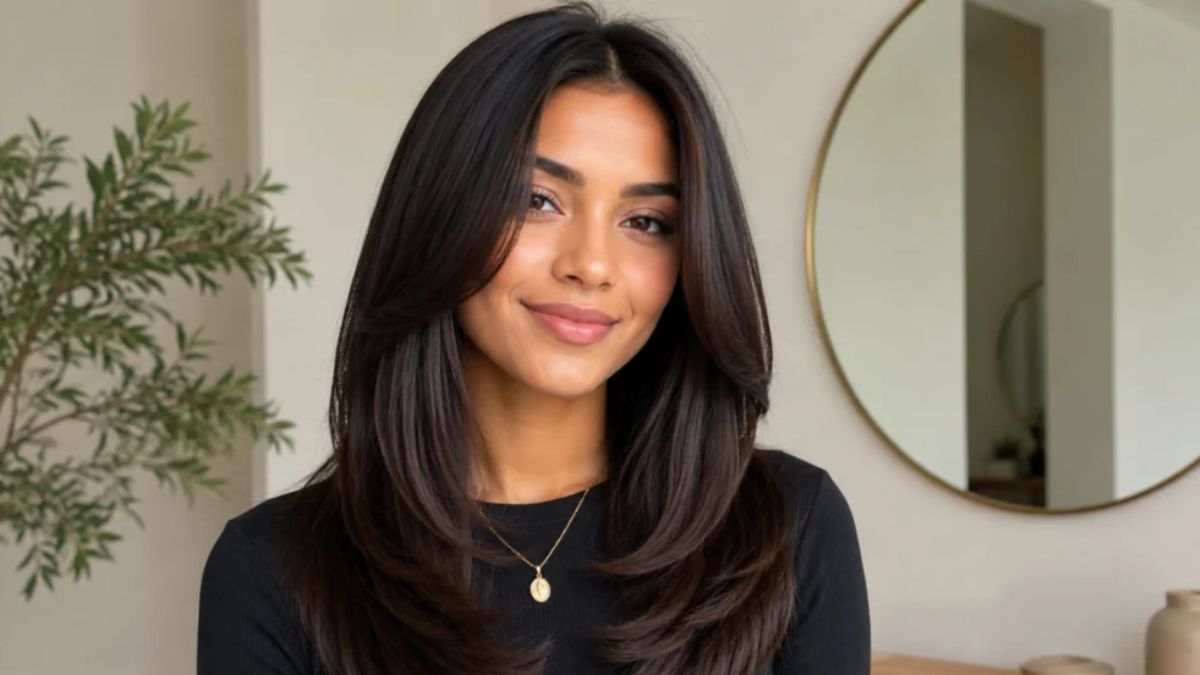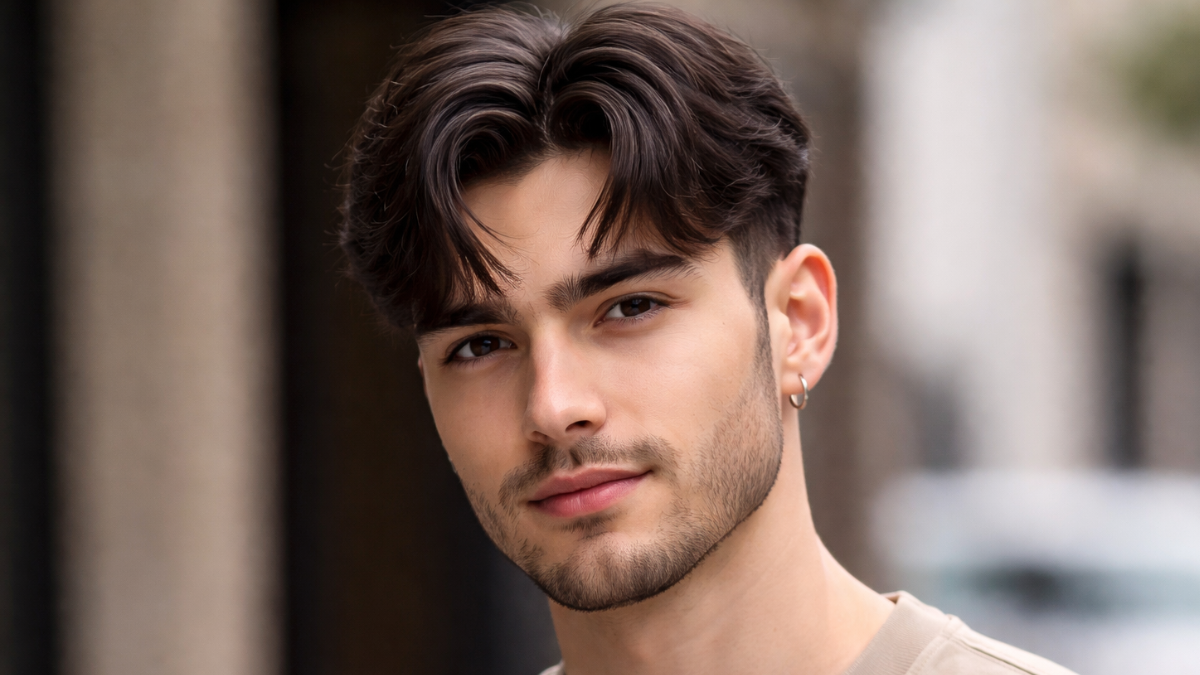
The bob is one of the most versatile haircuts you can get, but it flatters most when the variation suits your face shape. The wrong bob on the wrong face shape does not flatter. A blunt chin-length bob on a round face widens everything. A stacked bob with height at the crown makes a long face look longer. The right bob, sized and angled to match the face, flatters every feature.
This is not about restrictions. No face shape is barred from wearing any bob. It is about knowing which version of the bob does the most work for your specific proportions, so the cut reads as chosen rather than accidental. The best haircut is the one cut for your face, not the one on a Pinterest board.
These 17 bob hairstyles are organised by face shape: oval, round, square, heart, oblong, and diamond. Each includes the specific length, angle, fringe option, and styling guidance that makes the variation work for that face shape.
How to Identify Your Face Shape Before Choosing a Bob
Pull your hair fully back and photograph your face straight-on against a plain background. The proportions of the forehead, cheekbones, and jaw tell you the face shape category. Oval faces are longer than wide with a slightly narrowed jaw. Round faces are roughly as wide as long with soft, curved jaw angles. Square faces have a broad forehead and a strong, angular jaw of similar width. Heart faces have a wide forehead and cheekbones that narrow sharply to a pointed chin. Oblong faces are significantly longer than wide with a roughly even forehead-to-jaw proportion. Diamond faces are narrow at forehead and jaw with wide, prominent cheekbones.
Many people fall between two face shapes, and the bob is the cut most easily adjusted to flatter the exact combination. The face shape guides the length and the angle. Hair texture guides the finish and the weight distribution. Both matter.
Bob Hairstyles for Oval Face Shape
The oval face shape is the most proportionally balanced and suits every bob variation. The styling priority for oval faces is personal preference rather than correction. That said, the bobs that perform best visually on oval faces are those that do not hide the face’s balanced proportions behind excessive volume or fringe.
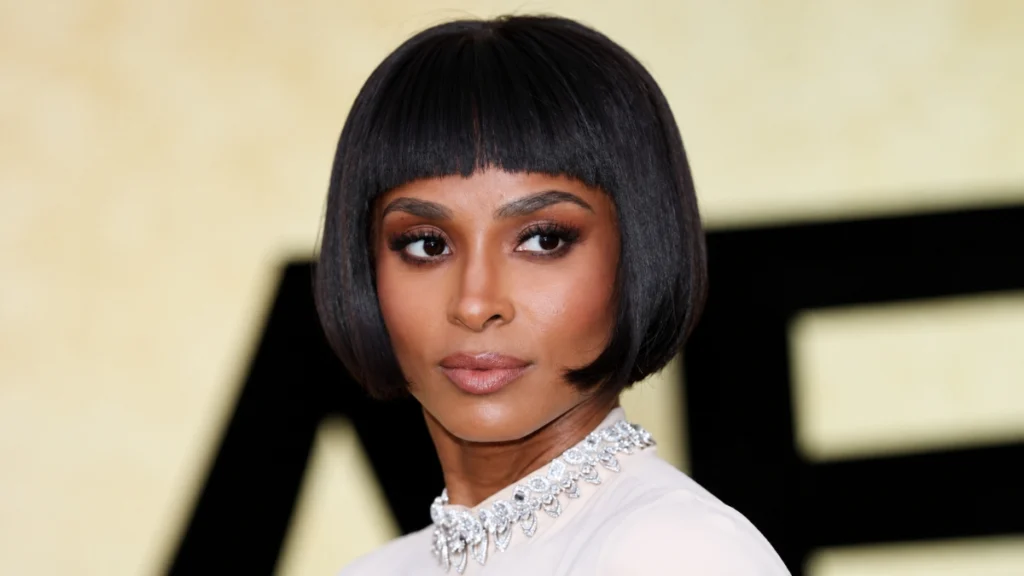
1. Classic Blunt Bob at Jaw Length
A blunt-cut bob landing at the jaw, perfectly even all the way around, with no graduation, no angle, and no layering. The straight-across hemline on an oval face creates a graphic, fashion-forward result that photographs with absolute precision.
It requires oval or slightly oval proportions to land correctly as a statement rather than as a cut that shortens the face. On an oval face, the balanced proportions let the hemline read as a design choice rather than a fix.
Style with a centre or deep side part. Blow-dry smooth for the graphic version or diffuse for a softer texture. Olaplex No.6 Bond Smoother pressed through damp lengths before blow-drying keeps the hemline sharp without frizz.
 Save
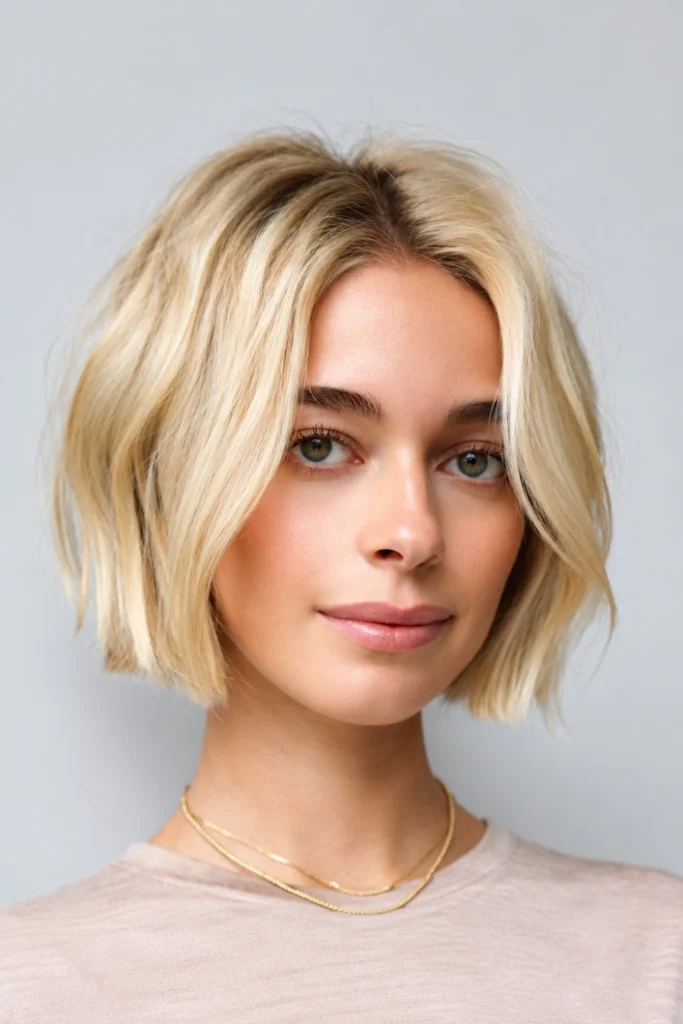
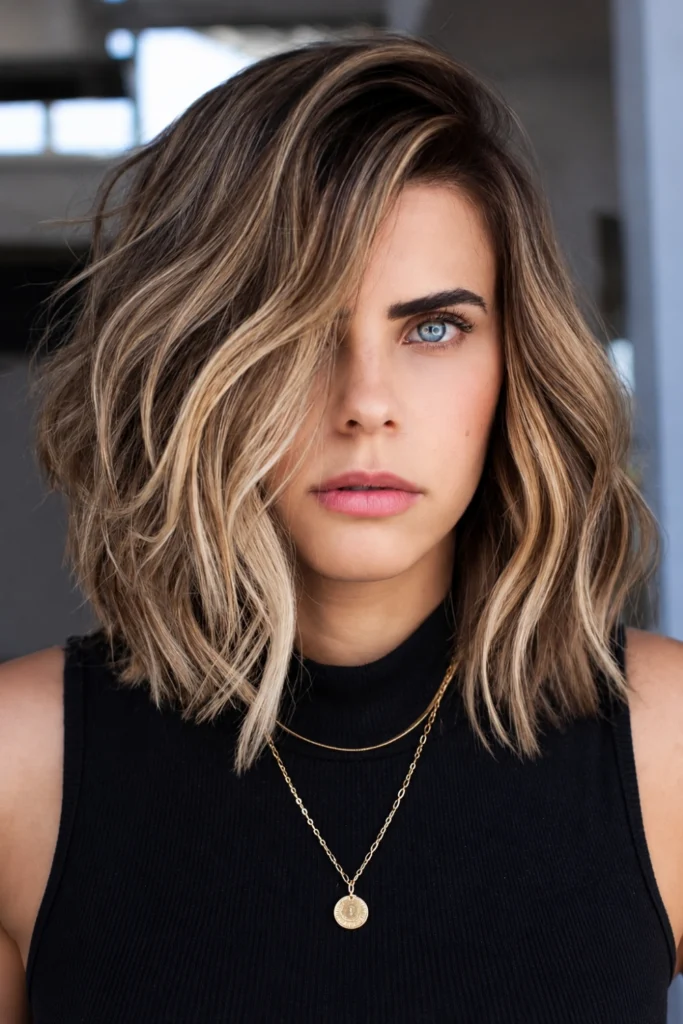
2. Textured Wavy Bob at Collarbone Length
A bob cut to the collarbone with soft, internal layers creating movement, styled with loose waves that break at the ends, the most effortless and universally flattering variation for oval faces.
The collarbone bob on oval proportions gives maximum versatility: worn straight it reads as polished, worn wavy it reads as undone and editorial. The internal layering removes bulk at the ends without shortening the perimeter, keeping the length while giving the waves somewhere to move. Many stylists see collarbone length as the sweet spot between chin and shoulder.
Wrap sections around a 32mm barrel to create soft waves, then break them apart with fingers rather than a brush. A light-hold texture spray over the finished look maintains the movement without making the waves stiff.
 Save
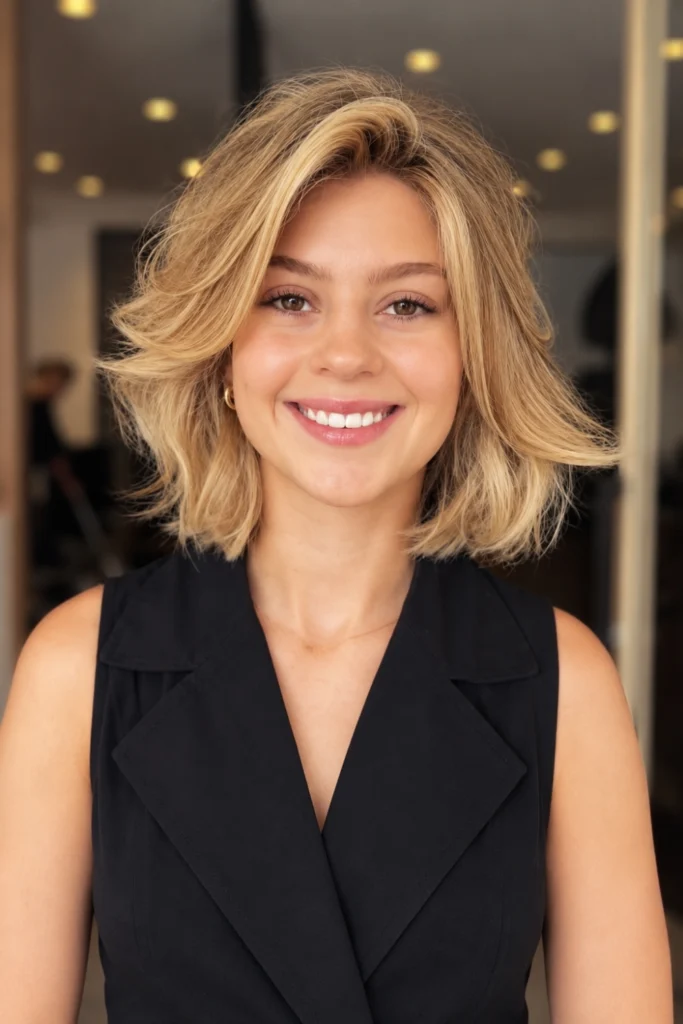
3. Sleek Side-Parted Bob with Curtain Fringe
A chin to jaw bob with a deep side part and curtain fringe that splits at the centre and falls to cheekbone level, framing the face without covering the forehead fully, one of the most popular bob looks right now.
The curtain fringe is one of the most popular bob variations. On oval faces it adds a soft face-framing element without altering the proportions. The fringe should land between the eyebrow and the cheekbone: too short reads as a micro bang, too long disappears into the bob and becomes a layer.
For more fringe ideas, see our micro bangs styles.
 Save
Bob Hairstyles for Round Face Shape
Round face shapes benefit from bobs that add vertical height or create angular lines that counterbalance the face’s circular proportions. The priority is length over the jaw and volume at the crown rather than the sides. A chin-length blunt bob adds width at the widest point of a round face. An angled bob that is longer at the front corrects this.
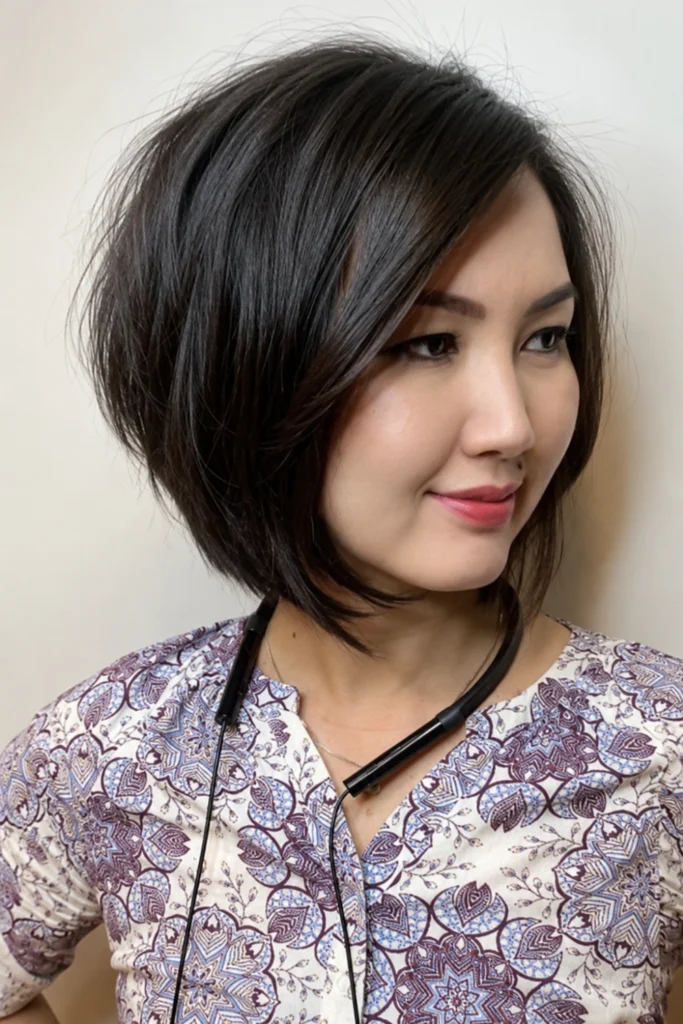
4. Angled A-Line Bob
A bob that is significantly shorter at the back, from nape to mid-skull, and angled down to a longer front section falling at or below the chin, the A-line creating a diagonal that adds visual length to the face.
The A-line bob is the most recommended cut for round face shapes because the angle draws the eye from the shorter back to the longer front, creating the vertical elongation that balanced proportions need. The angle should be steep enough to be visible from the front but not so extreme that it reads as asymmetric from the side.
Keep the back graduation clean. A stacky, layered back adds volume at the widest part of the head, which widens the silhouette further. A smooth, tapered back keeps the shape elongated.
 Save
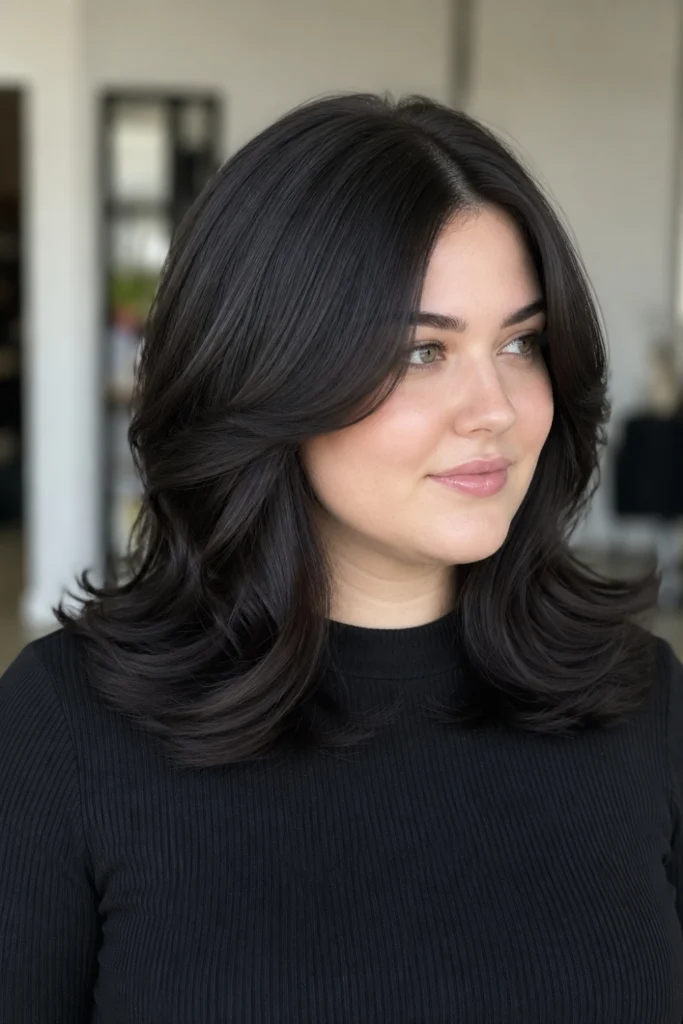
5. Long Bob with Face-Framing Layers
A bob that falls past the collarbone, sometimes called a lob, with face-framing layers cut from the cheekbone level that draw the eye forward and down rather than out to the sides.
The longer bob is the most forgiving option for round faces because the extra length creates vertical proportion simply by extending past the jaw. Face-framing layers from the cheekbone add the diagonal element that the angular jaw of a blunt bob cannot replicate at a longer length. The layers should curve toward the face at the front, not layer away from it. Away-from-face layers on a round face widens the jaw area.
 Save
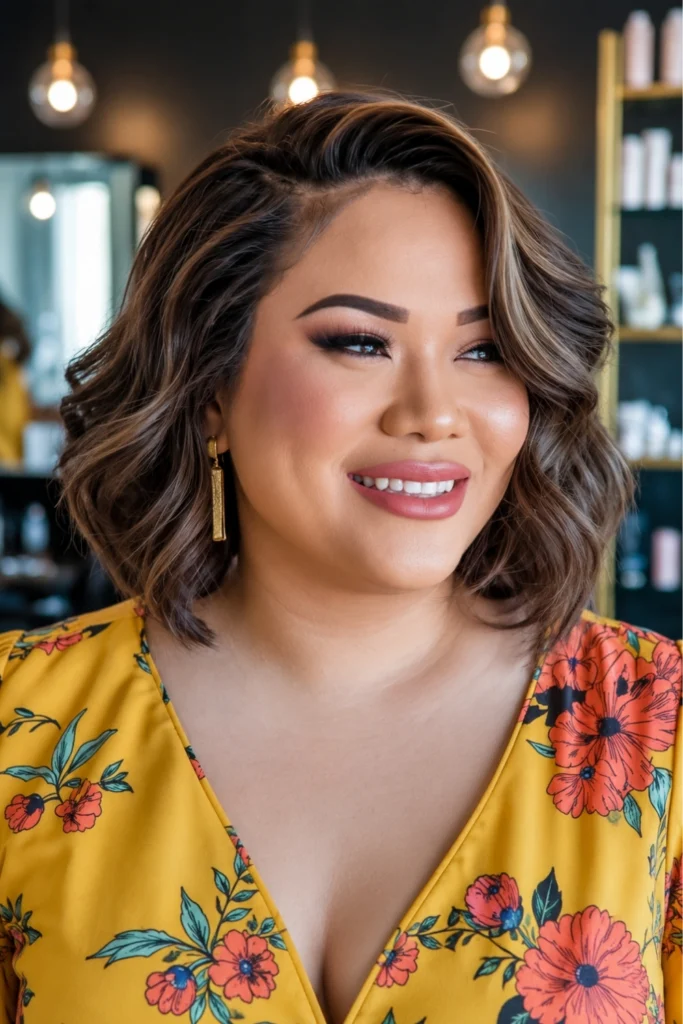
6. Side-Swept Bob with Deep Part
A jaw to chin length bob styled with an extreme side part that sweeps the majority of the hair across the forehead to one side, breaking the face’s symmetry and adding angular visual interest.
The deep side part is the styling technique that does the most work for round faces across any bob length. By sweeping the hair heavily to one side, the part creates an asymmetric line across the forehead that reads as an angular feature the naturally soft jaw cannot provide. This bob can be styled with the swept section tucked behind the ear for a sleeker version or left loose to fall across the cheek for a softer result.
 Save
Bob Hairstyles for Square Face Shape
Square face shapes have a strong, angular jaw and a broad forehead of similar width. The bob priority for square faces is softening the jaw angles and adding roundness at the temple and crown. Blunt straight-across hemlines at jaw level reinforce the square jaw rather than flattering it. Soft layers, waves, and longer lengths that fall past the jaw are the corrections.
7. Soft Wavy Bob Below the Jaw
A bob that falls one to two inches below the jaw in a soft, slightly layered cut styled with loose waves, the wavy texture adding the curved, organic lines that counterbalance the square jaw’s angular edges.
The waves are the functional element on a square face. A straight, smooth version of this bob at this length reads as a frame that highlights the jaw’s squareness by creating a flat edge along the perimeter at the same level. The waves break that flat edge visually, introducing curves where the face has angles. Any curl or wave through the ends of a jawline-length or below-jaw-length bob softens the overall impression significantly.
 Save
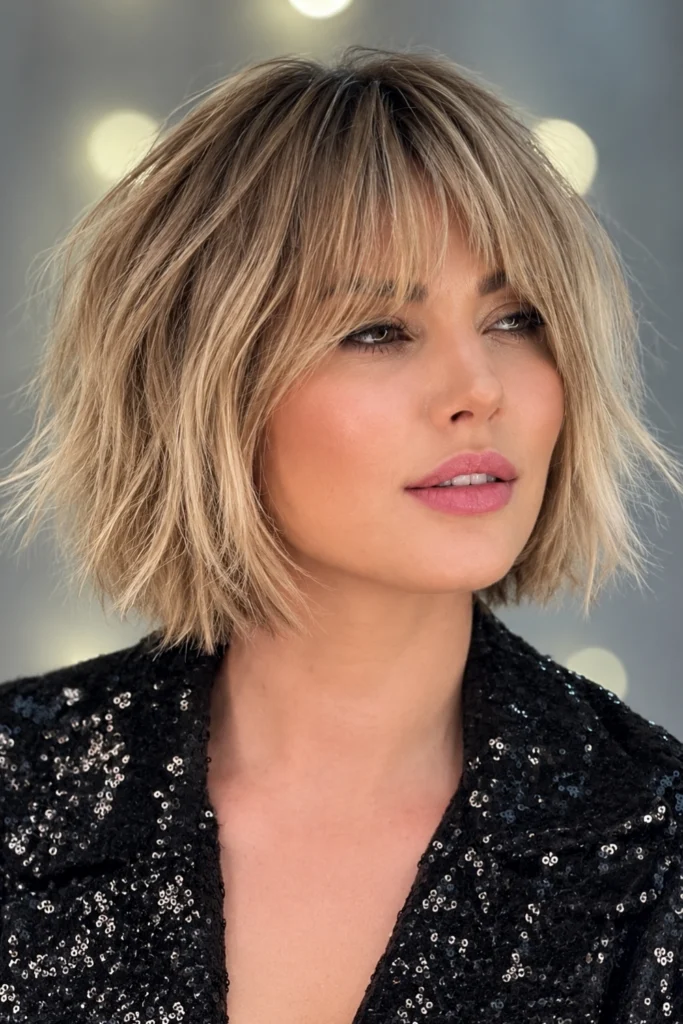
8. Layered Bob with Wispy Fringe
A chin-length layered bob with a soft, wispy fringe that falls to eyebrow level, the fringe breaking up the forehead’s width and the layers removing the blunt hemline that would otherwise sit directly against the jaw.
The wispy fringe is the tool that addresses the broad forehead of a square face, and the layering through the bob removes the flat perimeter line that accentuates jaw angles. A fringe is one of the best ways to break up a broad forehead on a square face, especially the wispy, undense version that sits lightly against the forehead rather than cutting across it as a straight line.
 Save
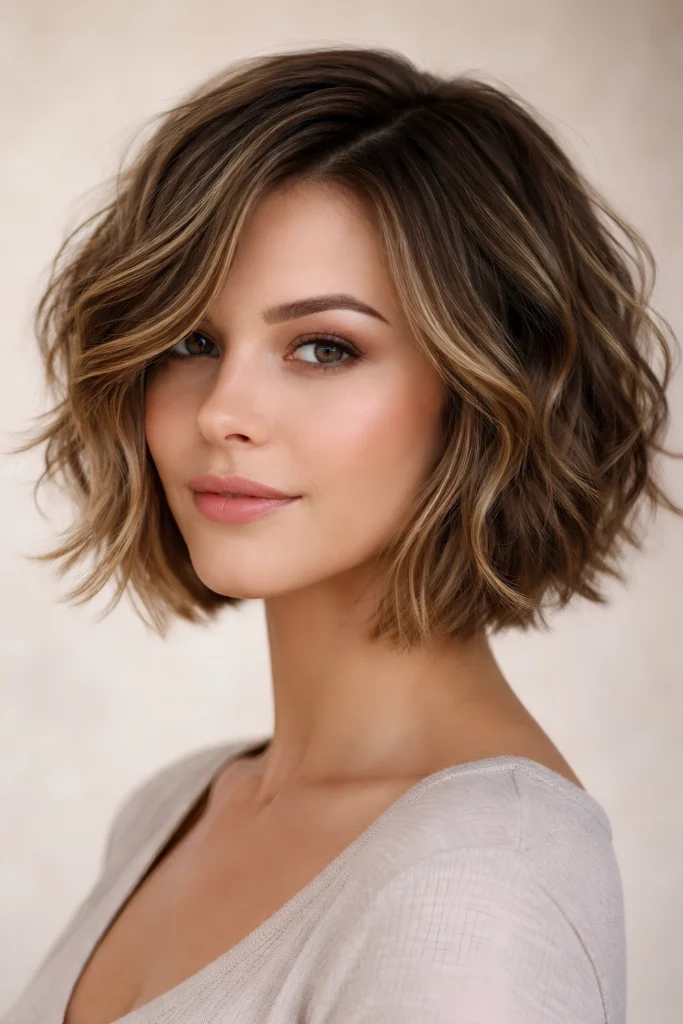
9. Textured Choppy Bob
A jaw-length bob with heavy point-cutting through the ends creating a choppy, deliberately uneven hemline, the textured perimeter removing the straight horizontal line that square jaw angles create when paired with a blunt bob.
The choppy bob uses the scissors to solve the same problem waves solve at a different texture level. Point-cutting through the perimeter of the bob creates a jagged, uneven edge that photographs as texture rather than as a flat line. On square faces this is the technique that allows a shorter bob, even chin-length, to work without emphasising the jaw angle. The choppiness needs to be intentional, not random: ask specifically for point-cutting at the ends rather than scissor-over-comb finishing.
 Save
Bob Hairstyles for Heart Face Shape
Heart face shapes have a wider forehead and cheekbones that narrow to a pointed chin. The bob priority is adding width at or below the jaw to balance the narrower lower face, while avoiding excessive volume at the crown or temples that would widen the already-wide upper portion.
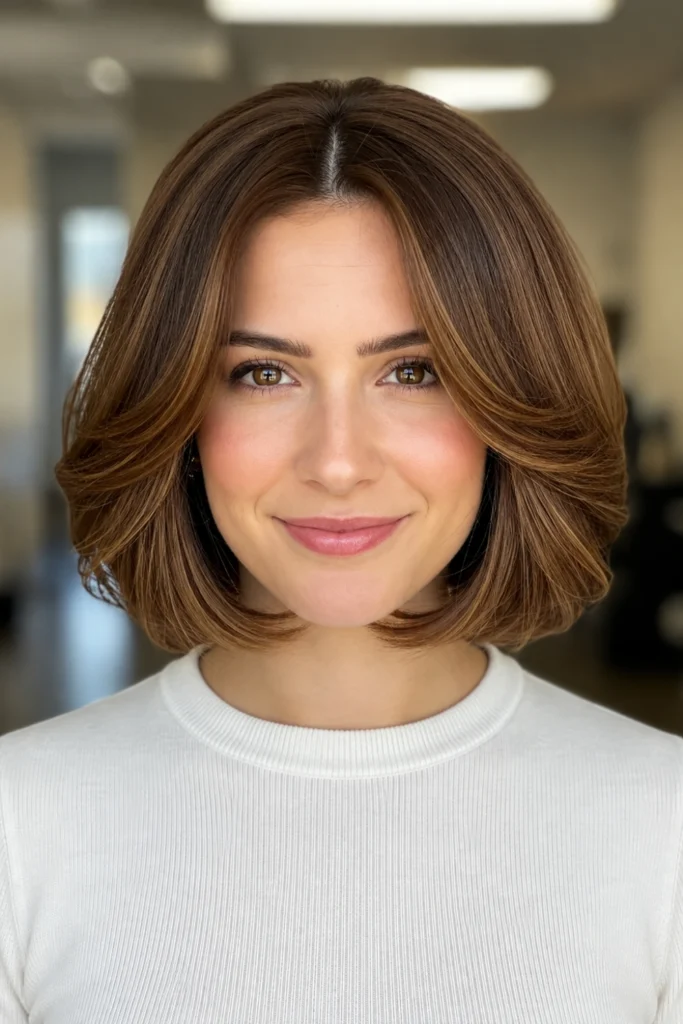
10. Chin-Length Bob with Volume at the Ends
A bob cut precisely at the chin with a slight flick or curl at the ends, the volume directed outward at chin level to add visual width exactly where the heart face needs it most.
The chin is the inflection point for heart face shapes. Volume above the chin accentuates the forehead width. Volume at or below the chin balances the pointed lower face. A chin-length bob with the ends styled outward rather than inward is the most direct application of this principle. A large round brush pulled outward through the last three inches of the length during blow-drying creates the flick without needing a curling iron.
 Save
11. Side Part Lob with Soft Layers
A longer bob falling to the collarbone or slightly past it with a soft side part and internal layers, the length and the side part breaking the forehead symmetry while the volume at the ends balances the pointed chin.
The side part on a heart face does the same work it does on a round face: breaking symmetry reduces the visual emphasis on the forehead’s width. The longer lob adds the chin-level and below-chin volume that shorter bobs cannot achieve. This is one of the most recommended variations for heart faces because it addresses both the wide upper face and the narrow lower face simultaneously.
 Save
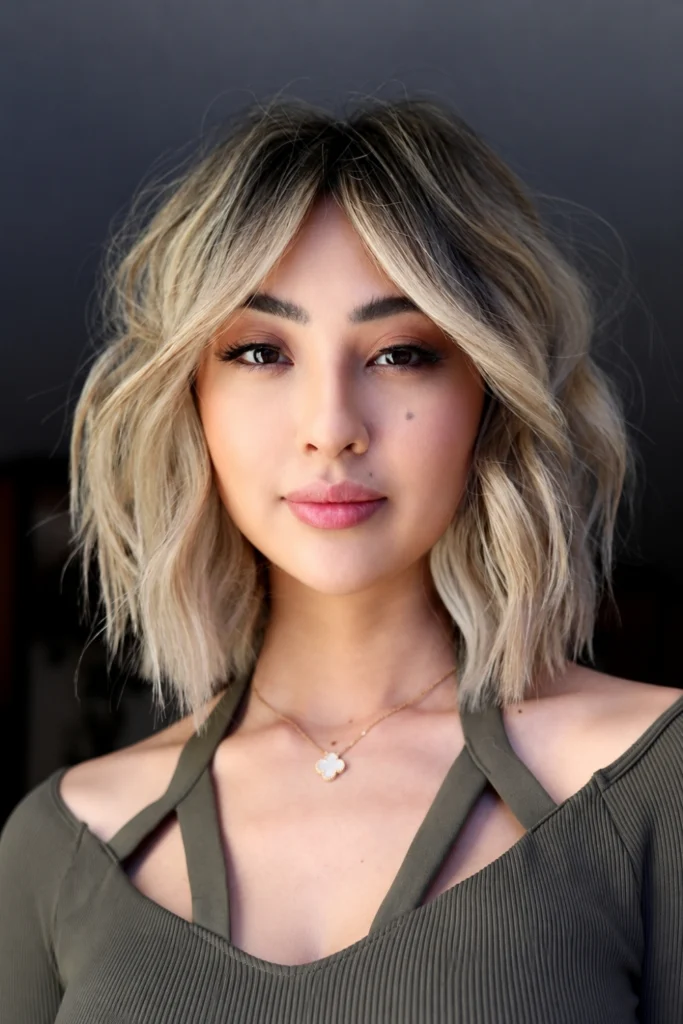
12. Bob with Curtain Fringe
A jaw to chin bob with curtain fringe parted in the centre and falling to cheekbone level, the fringe visually narrowing the forehead and the bob’s volume at the ends adding width below.
Curtain fringe on a heart face does specific structural work: by falling to the cheekbones and creating the impression of a narrower forehead, it rebalances the wide-to-narrow proportion that defines the face shape. The bob below it adds width at jaw level. The two elements together create the visual middle ground between the heart face’s wide upper zone and narrow lower zone. This is the most complete correction available for a heart face in a single bob cut.
 Save
Bob Hairstyles for Oblong Face Shape
Oblong face shapes are significantly longer than they are wide, with a roughly even forehead and jaw width and a face that extends vertically. The bob priority is adding width at the sides to reduce the visual length and avoiding any cut that adds more vertical height at the crown or falls very long and straight, which adds to the length further.
13. Blunt Bob at Chin or Above
A blunt, straight-across bob at chin length or shorter, with no angle and no graduation, the width of the blunt hemline adding horizontal emphasis that counterbalances the face’s vertical length.
The oblong face shape is the one where the blunt bob performs most effectively as a correction tool. Where the blunt hemline at jaw level widens a round face, it adds the horizontal width that an oblong face specifically needs. The blunt chin bob is one of the best cuts for oblong proportions, and the shorter the blunt hemline, the more strongly it counteracts vertical length. An above-chin blunt bob is even more effective than a chin-length version for very long face proportions.
Like this blunt look? The hime cut uses the same straight-across cutting at cheek and jaw level.
 Save
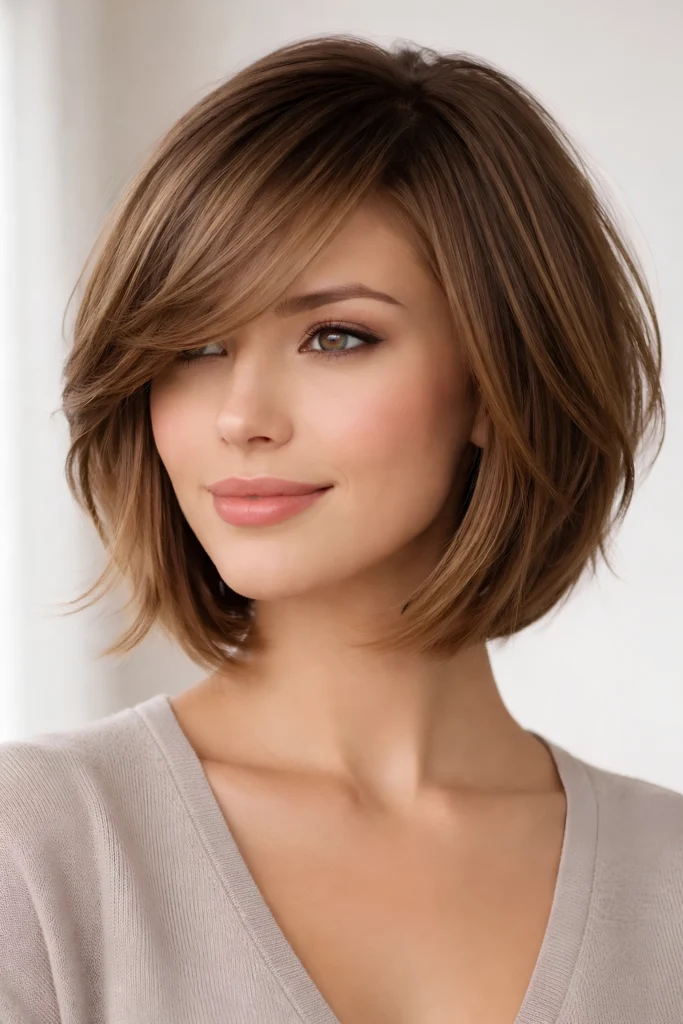
14. Bob with Side Fringe
A chin to jaw bob with a thick, side-swept fringe that covers part of the forehead, the fringe shortening the visual face length from the top while the bob’s width at the sides adds horizontal breadth.
The side fringe is the tool that shortens the face from the top on an oblong shape. Combined with a bob that adds width at the sides, it produces the most complete visual correction available. The fringe should be dense enough to cover the upper third of the forehead. A too-thin or wispy fringe on an oblong face does not have enough visual mass to break the vertical length.
 Save
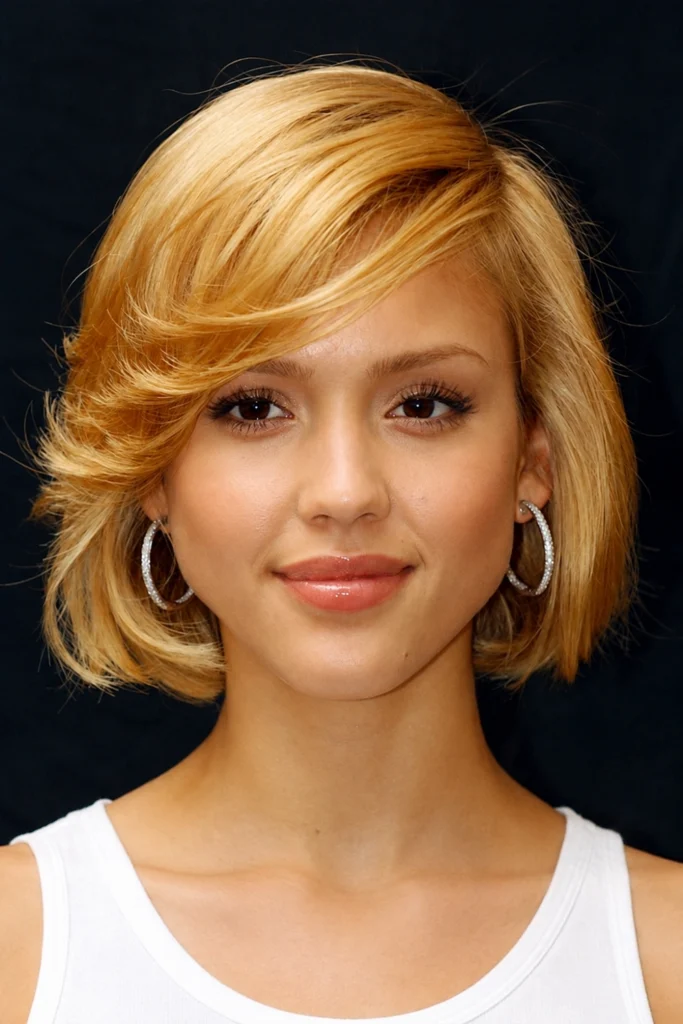
15. Stacked Bob with Volume at the Sides
A stacked bob with shorter layers through the crown and graduation that creates volume and width at the sides of the head, directly counteracting the vertical length of an oblong face by widening the overall silhouette.
The stacked bob is the one bob type that works most against oblong faces when the stacking creates vertical volume at the crown. But a stacked bob that directs volume outward to the sides rather than upward, using layers that build toward the ears and temples, creates exactly the horizontal width an oblong face needs. The instruction to the stylist: graduation at the sides, not the crown. Volume at the ears, not the top.
For longer layered options, see our medium layered hairstyles.
 Save
Bob Hairstyles for Diamond Face Shape
Diamond face shapes have a narrow forehead, wide prominent cheekbones, and a narrow pointed chin. The bob priority is adding width at the forehead and jaw to balance the cheekbones, and avoiding cuts that add width through the already-prominent cheekbone zone.
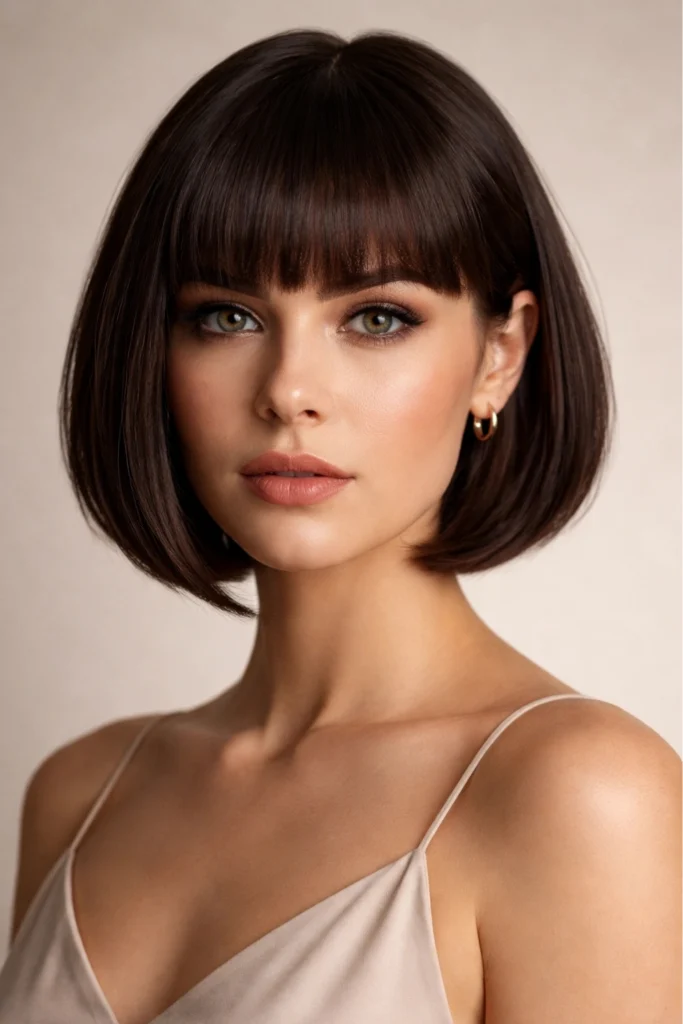
16. Bob with Full Fringe
A chin to jaw bob with a full, blunt or slightly textured fringe cut across the forehead at eyebrow level, the fringe adding visual width at the forehead that narrows the cheekbones by comparison.
The full fringe is the most direct correction for the narrow diamond forehead. It adds the visual width the natural hairline does not provide. On a diamond face, a full fringe at eyebrow level combined with a bob at jaw level adds width at both the top and bottom of the face simultaneously, which is the dual correction the cheekbone-dominant face shape needs. The fringe should be wide enough to reach past the temples, not cut narrow in the centre only.
 Save
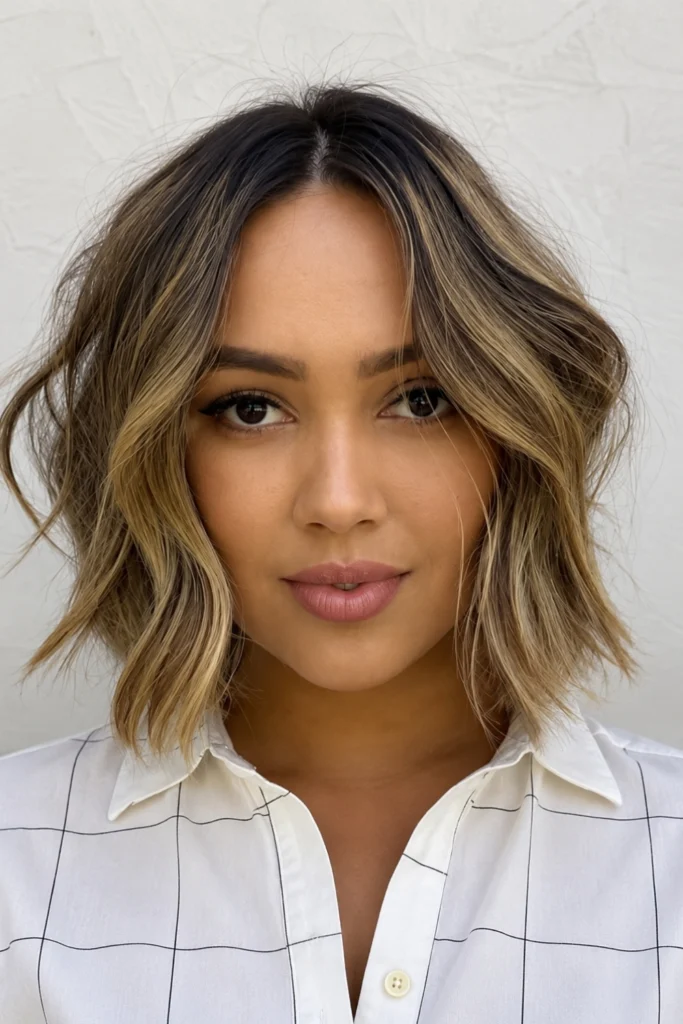
17. Jaw-Length Bob with Volume at the Ends
A bob cut at jaw length with graduation through the ends that creates a slight outward flare, adding visual width at jaw level to balance the narrower chin and prominent cheekbones of the diamond face.
This is the diamond face shape version of the heart face chin-length bob with outward volume. On a diamond face the jaw is narrow rather than pointed, and the volume at jaw level is the correction that makes the face appear more balanced. The outward flare at the ends of the bob is created by blow-drying with a large round brush pulled outward through the last three inches of the length, or by a slight graduation built into the cut by the stylist. Without the outward volume the bob sits close to the jaw and leaves the narrow lower face looking even narrower.
 Save
Styling Tips for Every Bob Face Shape
The Parting Changes Everything
The parting is the fastest way to change how a bob reads against a face shape without returning to the salon. A centre part on any bob emphasises symmetry, which flatters oval and oblong faces most directly. A deep side part adds asymmetry and visual width on one side, which flatters round and square faces. A zig-zag or slightly off-centre part softens the parting line and suits heart and diamond faces.
You can change your parting every day. You can’t change the cut. Making an informed parting decision before leaving the house adds a free styling variable that most women do not think of as an active tool.
Products That Work for Every Bob Length
Olaplex No.6 Bond Smoother pressed through damp lengths before blow-drying produces the smooth, frizz-free finish that makes blunt bobs read cleanly. Bumble and bumble Surf Spray misted over dry hair and scrunch-dried creates the textured wave finish that adds width and softness for square and oblong face bobs. A pea-sized amount of Moroccanoil Treatment worked through the ends of any bob adds shine and weight that prevents the hemline from lifting or separating in humidity.
Frequently Asked Questions
Which bob suits a round face shape?
An angled A-line bob, a long bob with face-framing layers, or a side-swept bob with a deep part all suit round face shapes. The shared principle is adding vertical length or angular lines that counterbalance the face’s circular proportions. The cuts to avoid on a round face are blunt straight-across bobs at chin or jaw level, which add horizontal width at the widest point of the face.
What is the most flattering bob for a square face?
A soft wavy bob that falls one to two inches below the jaw, a layered bob with a wispy fringe, or a choppy textured bob all flatter square face shapes. The priority is softening the jaw angles through waves, layers, or a choppy hemline rather than reinforcing them with a blunt straight edge at jaw level.
Does a blunt bob suit all face shapes?
No. A blunt bob suits oval and oblong face shapes most directly. On oval faces it reads as a fashion-forward statement cut. On oblong faces the horizontal hemline adds width that counteracts the face’s vertical length. On round faces the blunt jaw-level hemline adds width at the widest point of the face and is generally avoided. On square faces a blunt hemline reinforces the jaw angle. On heart and diamond faces the effect depends entirely on the length and whether fringe is added.
Can you get a bob with a fringe on any face shape?
Yes, but the fringe type changes by face shape. Heart faces benefit most from curtain fringe at cheekbone level, which narrows the visual forehead width. Oblong faces suit a dense side-swept fringe that shortens the visual face length from the top. Diamond faces suit a full, wide fringe at eyebrow level that adds width to the narrow forehead. Square faces suit a wispy, lighter fringe that breaks up the forehead’s width without adding a strong horizontal line. Oval faces can wear any fringe variation.
How often does a bob need to be trimmed?
A bob needs a trim every four to six weeks to maintain the shape. Blunt bobs specifically require the most frequent attention because the straight hemline shows growth and split ends more visibly than layered cuts. Textured, layered, and wavy bobs can stretch to six weeks between trims before the shape begins to lose definition. The neckline area of a shorter bob or stacked bob needs the most frequent attention, sometimes as often as every three weeks for very clean necklines.
Final Thoughts
The bob is the haircut that gives the most back when it is chosen correctly for the face in front of it. Seventeen variations across six face shapes gives every woman a specific starting point, but the conversation at the salon is where the variation gets tailored further by texture, density, and lifestyle. Bring two or three reference images. Know the face shape. Tell the stylist what to prioritise.
The right bob does not just suit the face. It makes the face the reason you got the bob in the first place.